When it comes to construction, having the ability to quickly and accurately produce high-quality prints directly on the job site is crucial.
Unlike main construction offices where the majority of plans are printed, job sites present unique challenges that require specialized printing solutions.
At Steven Enterprises, we work with general contractors and project managers every day to recommend the right large format printers for job site trailers.
From architectural designs to complex construction plans that need immediate redlining, having the right printer on-site can make the difference between staying on schedule and costly delays.
In this blog post, you’ll learn about the latest compact models in 2025, designed to fit in tight trailer spaces.
Why General Contractors Need On-Site Printers
Unlike architectural offices where plans are drafted, construction sites are where plans are executed and often revised.
Job sites typically involve walking the site with prints in hand, collaborating with subcontractors like electricians, plumbers, and fire sprinkler installers, and making real-time adjustments.
The ability to perform “redline markups” and send immediate feedback to architects is essential for keeping projects on track.
With a large format printer on-site—often housed in a trailer—general contractors can manage these tasks efficiently, reducing downtime and avoiding costly delays.
However, space is a major constraint: trailers typically offer only 5-7 feet of space in a corner, making compact size a top priority.
Top Features General Contractors Should Look for in Large Format Printers
Speed and Efficiency: Time is money, and in construction, delays are costly. Printers that deliver quick prints without sacrificing quality are crucial for lower-volume on-site needs.
Scanning Capabilities: Since redlining is a primary function, integrated scanning capabilities are essential for digitizing marked-up plans and sending them back to project teams.
Dual Roll vs. Single Roll: Consider whether you need the flexibility of dual rolls for different paper sizes or if a single roll setup meets your volume needs.
Operating Costs: With varying print volumes, understanding ink costs and efficiency becomes crucial for budget management.
Top Large Format Printers for Construction Job Sites
The XT-950 is a compact, single-roll printer with an integrated scanner, perfect for sites that primarily work with one paper size (24″, 30″, or 36″). Its smaller footprint makes it ideal for the tightest trailer spaces.
This single-roll MFP includes a scanner for seamless redline markups and fits easily into tight trailer spaces with its 36-inch footprint.
It’s ideal for teams that print less but need reliable on-site capabilities for technical plans and annotations. We have seen this model excel on job sites where space and simplicity are key.
The T-2600 offers dual-roll capability, making it more versatile for sites that need to print multiple paper sizes without constant roll changes. It includes scanning functionality essential for redlining workflows.
As a dual-roll machine, it handles multiple paper sizes without constant switching, ideal for job sites with slightly higher printing needs than a single-roll option.
It offers the fastest print speed and automatic print stacking, catering to AEC, GIS, and MCAD professionals who need precise maps, technical drawings, and renders with crisp text.
Despite being suitable for job sites, the 3800 offers the best combination of speed, quality, and operational efficiency. While larger than other options, it still fits within typical trailer space constraints.
Unlike older models with price tags exceeding $100,000, this printer offers affordability without compromising performance.
Compared to the 6-color T-2600, the XL 3800 uses four inks, lowering costs while keeping speed.
That balance of efficiency and performance makes the HP DesignJet XL 3800 our top choice for construction job sites.
Key Features:
Dimensions: 63.11″ width x 24″ depth
4-color ink system (lower running costs than 6-color systems)
Superior print speed and quality
Dual-roll capability
Integrated scanner
Streamline Your Construction Projects with the Right Large Format Printer
Equipping your job site with a compact, capable large format printer ensures smoother operations, adherence to budgets, and fewer delays.
By choosing a model tailored to the unique constraints of job site trailers, you empower your team to handle redline markups and technical plans efficiently.
Ready to Upgrade?Fill this form today or call us at 800-491-8785 to discuss which large format printer solution best fits your construction project needs and trailer configuration
High-volume sign shops producing car wraps, outdoor banners, or custom wallpaper all have one thing in common. They’re all dealing with the challenge of creating durable, scratch-resistant prints that can withstand real-world abuse.
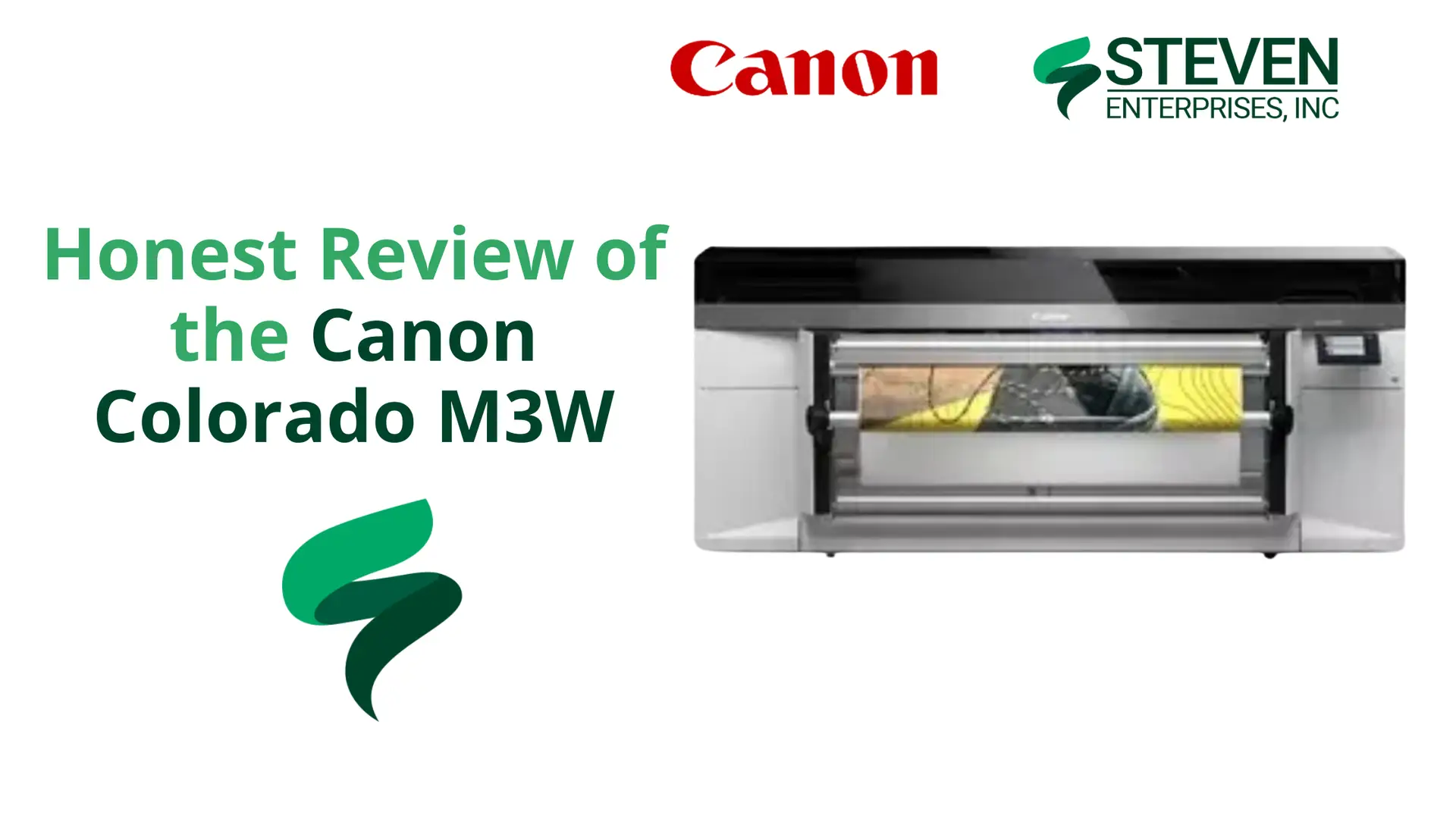
The Canon Colorado M3W was built specifically to solve this problem.
At Steven Enterprises, we have tested many large-format printers, but the Canon Colorado M3W stands out for one reason. Durability.
It’s built for businesses that demand durability without compromise. This isn’t for small shops with occasional jobs—it’s a true industrial workhorse made for high-volume production.
Here’s our honest assessment of what the Canon Colorado M3W delivers, where it excels, and whether it’s the right investment for your operation.
What Makes the Canon Colorado M3W Different?
The Canon Colorado M3W is a large format UVgel printer capable of producing a wide range of applications with high quality and durability. The “W” in the model name stands for white ink capability, which differentiates it from other Colorado machines and opens up entirely new application possibilities.
The printer uses Canon’s UVgel technology, which offers excellent color and dimensional stability, resulting in sharp, accurate prints.
This technology is what sets the M3W apart from traditional solvent or latex printers, it creates prints that are instantly dry, scratch-resistant, and built to last.
Key Features of the Canon Colorado M3W That Matter for Your Business
The Colorado M3W introduces several standout features that differentiate it in the market:
UVgel Technology
Canon’s UVgel technology powers the entire Colorado series.
Unlike solvent or latex, it uses gel-based UV-curable ink that sets on contact. UV LED lamps then cure the ink, delivering fast, durable, and vibrant prints without delay.
This provides instant drying (no waiting for outgassing), and results in robust, scratch-resistant prints with superior quality.
UVgel prints have excellent color vibrancy and consistency, with precise dot placement and almost no dot gain or bleeding.
The cured ink forms a smooth, thin layer that is flexible and won’t crack – Canon now specifies up to 185% stretchability for UVgel 460 inks, which is crucial for applications like vehicle wraps.
Additionally, UVgel’s low curing temperature means you can print on heat-sensitive materials (like thin films or vinyl) without warping.
White Ink
White ink is notoriously tricky in the printing world, often prone to clogging or settling in the lines.
Canon tackled this by developing a white UVgel ink that is “the same as the CMYK” in terms of how it behaves. It circulates in the system to prevent settling, and the printer has automated maintenance routines to keep the nozzles firing (so you don’t need daily manual purges).
As a result, Canon markets it as “White ink without worry,” allowing customers to use white ink hassle-free with spectacular results.
In practice, having white ink expands your capabilities: you can print opaque white underlays on clear window film, make white text or graphics on colored media, or do multi-layer prints (e.g., color-white-color for backlit applications).
FLXfinish+
FLXfinish+ lets you switch between a glossy finish and a matte finish on the fly, without needing to change inks or add a varnish.
By adjusting the LED curing process, the printer can make the same ink either cure flat (matte) or shiny (gloss).
You can even have mixed matte and gloss elements in one print for creative effects.
For example, you could print a wallpaper with a matte background but gloss-highlighted text or logos, all in one pass. This “spot UV” look is achieved without an extra print step or coating.
It’s a great way to differentiate prints and add value – something usually not possible on traditional solvent or latex machines.
The UVgel ink’s immediate curing means it doesn’t bleed on porous media and doesn’t distort thin materials.
For companies that produce diverse products (wall murals one day, vehicle wraps the next, then decals or posters), having one printer that can handle all these applications is incredibly efficient.
The Colorado’s output is also certified for indoor use – it has various environmental certifications (GREENGUARD Gold, AgBB, etc.) ensuring the prints are safe for hospitals, schools, or homes.
This is crucial for wall coverings and retail signage. Clients in these spaces expect odorless, low-emission prints for indoor environments.
Real-World Feedback from the Colorado M3W
Partition Graphics (UK)
This company invested in a Colorado M3W to replace multiple older eco-solvent printers. Their managing director reports “The Colorado M3W is excellent for all our applications – from printing sophisticated fade effects and white ink on optically clear film to producing high quality wallcoverings, graphics, and vinyls. It really does everything we need.”
Overall, their experience shows the M3W delivering on its promises of quality, versatility, and productivity.
808Wraps (Hawaii, USA)
808Wraps took on the challenge of wrapping a Tesla Cybertruck using the Colorado’s UVgel prints. They found that the vibrancy and durability of the prints were outstanding – critical for vehicle wraps which face sun, rain, and abrasion. “The prints are highly resistant to scratching and abrasion, and they withstood UV exposure, maintaining vibrancy even in Hawaii’s intense sunlight,”said the company’s CEO.
The Colorado’s rapid output also helped them meet tight deadlines for high-volume projects, which is a huge factor in the vehicle wrap business where downtime = lost revenue.
Moreover, because UVgel prints are dry and have stable dimensions, installers appreciate that panels align consistently edge to edge (no shrinkage), which is important when wrapping large vehicles or doing panelled wall murals.
Canon has even gotten a 3M MCS warranty on UVgel wraps, meaning 3M backs the durability of wraps printed on the Colorado when using their approved materials.
Online Forum Feedback
In industry forums (such as Reddit and Signs101), early adopters have also shared candid opinions.
In other words, this printer shines in a production environment where it’s running many hours a day; small shops with only occasional large-format jobs might find it hard to justify the cost.
Owners often highlight the printer’s color consistency and cost savings. The Colorado delivers reliable output, thanks to UVgel chemistry and automation. This consistency reduces print waste significantly.
And several users note that ink consumption per square foot is low – one user happily reported “the inks are cost effective” even while running large volumes of adhesive vinyl prints.
Some forum members compared the Colorado M3W with HP Latex printers (which are another popular choice for indoor/outdoor graphics and also offer white ink on certain models).
One person pointed out that the Colorado’s modular upgrade path is a big advantage – “unlike the HP, if you grow out of the M3 and want the M3W or the M5W, you just pay for the add-ons. That’s a lot cheaper than going from a Latex 700W to an 800W, etc.”
Who Stands to Gain the Most from the Canon Colorado M3W?
The Canon Colorado M3W is specifically built for:
Large Sign & Graphics Shops.
If your shop produces a high volume of banners, retail signage, posters, window graphics, and trade show displays, the Colorado M3W was made for you. It can handle day-to-day sign printing at high speed, maintaining consistent color across long runs (important for big brand jobs). For instance, you could print dozens of retail posters or outdoor banners in a single shift and they’d all come out uniform and immediately ready to hem or grommet.
Vehicle Wrap & Fleet Graphics Producers.
Car wraps, bus wraps, fleet decals, etc., benefit from the ink’s strong adhesion and color vibrancy. The prints stretch cleanly over rivets and curves and resist damage, even during vigorous repositioning and squeegeeing.
Vehicle and fleet branding companies can print wraps quickly and maintain consistent color from panel to panel with ease.
Fleet graphics in particular often require reliable repeatability – if you’re wrapping 10 vans with the same design, the first and tenth should look identical; the Colorado’s automation and stable output help ensure that.
Wallpaper & Wallcovering Manufacturers.
Custom wallpapers and wallcoverings are growing in popularity, and the Colorado M3W meets this demand extremely well. It prints on PVC-free wallpaper, self-adhesive vinyl, canvas, and more—producing detailed, color-stable murals for interior spaces.
Point-of-Purchase Displays & Backlits.
The retail POP market often demands premium quality and sometimes unique media like backlit films or clings. The M3W’s high resolution and color gamut deliver sharp, eye-catching point-of-purchase graphics that can elevate in-store displays. White ink lets you print double-layer graphics on clear film for vibrant lightboxes or window clings with impact.
Print Farms and Trade Print Suppliers.
The Colorado M3W suits wholesale printers and print farms that need high output, reliability, and easy job management. The reliability and self-maintenance mean you can line up multiple jobs and let the machine go. With an efficient workflow, you could replace multiple slower printers with a single Colorado, reducing floor space and operator oversight.
The Bottom Line: Is the Canon Colorado M3W Right for You?
Of course, “honest review” means acknowledging the considerations: the Colorado M3W is a significant investment.
The Colorado M3W is not aimed at small sign shops or hobbyist use. Its price point and size only make sense if you have a steady stream of work.
However, if you’re a small shop doing occasional projects or primarily indoor applications, the M3W might be overkill.
The investment makes sense if you need features like scratch resistance, white ink, mixed finishes, and industrial durability.
]]If your library or archive still relies on photocopies or hand-held cameras, you’re overdue for an upgrade.
Let’s say you are standing in front of a century-old yearbook. Its pages are yellowed with age and its binding is so fragile that opening it feels like you’re going to wreck it.
You know these memories need to be preserved digitally, but you’re not sure which scanner can handle the job without damaging this irreplaceable artifact.
At Steven Enterprises, we help libraries, museums, archives, and organizations every day choose the right Bookeye scanner for their digitization projects.
The key is understanding that not all scanning needs are the same and neither are all Bookeye scanners.
Here’s your complete guide to selecting the perfect Bookeye scanner for your specific digitization needs, whether you’re preserving historical documents or converting everyday materials.
What Makes Bookeye Scanners Different from Regular Scanners?
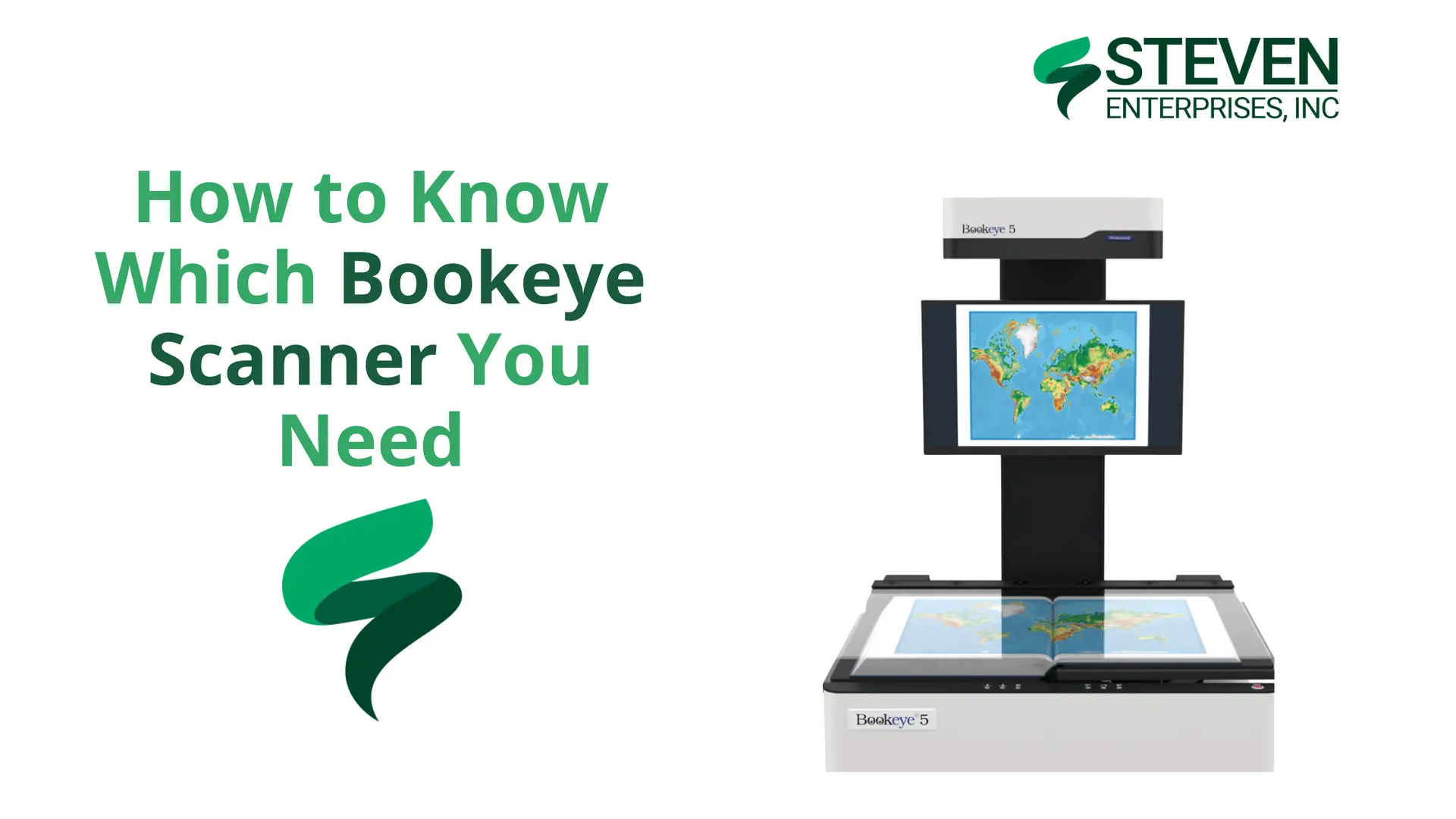
Bookeye scanners are professional-grade overhead book scanners designed specifically for digitizing bound materials without damaging them. The scanner has moveable cradles for the left and right sides of books.
The scanner can be left flat or raised for gentle handling of books or other types of bound or fragile material that flat scanners simply can’t handle safely.
Unlike flatbed scanners that require you to press books flat (potentially damaging the spine), Bookeye scanners use a V-shaped cradle system that supports books naturally.
This means you can digitize fragile historical documents, rare books, and bound materials without the stress of forcing them onto a flat surface.
Top Use Cases of Bookeye Scanners
The most common reason organizations invest in Bookeye scanners is simple: they need to make their old things digital. This includes:
Scanning old books that are too fragile for traditional flatbed scanners
Digitizing historical yearbooks to preserve memories and make them accessible
Converting archives of bound documents, ledgers, and records
Preserving rare manuscripts and historical texts
Creating digital copies of frequently-used reference materials
Understanding the Bookeye Scanner Lineup
Choosing the right Bookeye scanner comes down to understanding your specific needs. Here’s how the main models break down:
The Bookeye 5 V3 Overhead Book Scanner is a self-service book scanner for formats 50 % larger than A3 (390 x 480 mm/ 15.3 x 18.9 inch) makes it perfect for normal-sized books and most common digitization tasks.
Best for:
Standard library books and textbooks
Yearbooks and photo albums
Regular archival documents
High-volume scanning projects
Self-service applications
The V3 is the most popular choice because it handles the majority of scanning scenarios while remaining cost-effective and user-friendly.
The Bookeye 5 V1A Book Scanner Pro Edition is a high quality extra-large book scanner for professionals.
Scan large deed books, maps, and old ledgers with this scanner when standard scanners simply aren’t big enough.
Best for:
Large historical ledgers and deed books
Oversized maps and architectural drawings
Extra-large yearbooks and photo albums
Specialized archival collections
Museums with unique large-format materials
Key Features That Matter for Your Decision
Scanning Platform Size
The most noticeable design change between the two models is the scanning platform size, which is larger on the Bookeye V2 than the Bookeye V3.
The V3 model features a 3 inch by 5-inch decrease in scanning platform size, making the unit more compact and affordable when compared to the V2 model.
Choose based on the largest materials you need to scan regularly.
Professional vs. Self-Service Use
Bookeye 5 V3 has all the advantages of a more expensive standalone device. Outfitted with an integrated color touchscreen and monitor, Bookeye 5 V3 can reach unrivaled scanning speeds and process large volumes of data independent of any external peripheral devices making it perfect for self-service environments.
Consider whether you need a scanner for trained operators or public use.
Image Quality Requirements
The Bookeye 5 V3 Professional Book Scanner is a FADGI compliant, CCD camera based book scanner for Libraries, museums and historical society’s high quality Archive needs ensures your digitization meets professional archival standards.
Selecting the wrong Bookeye scanner can be expensive. Too small and you’ll struggle with larger materials or need multiple scanners. If it is too large, you might end up paying for capabilities you don’t need. Too basic and you might not achieve the image quality your projects require.
That’s why we always recommend a consultation to review your specific materials and requirements before making a decision.
Ready to Choose Your Ideal Bookeye Scanner?
Book scanners serve libraries, archives and digitization projects exceptionally well. They digitally preserve bound materials for future generations. Nonetheless, maximizing your investment depends on proper setup and training.
Our team provides comprehensive installation and training to ensure your staff can maximize the capabilities of your chosen Bookeye scanner from day one.
Don’t risk choosing the wrong scanner for your valuable materials.
There’s nothing worse than being in the middle of a critical print job when your large format printer suddenly stops working. The deadline is approaching, your client is waiting, and you’re staring at error codes that might as well be written in a foreign language.
At Steven Enterprises, we have built our reputation on being the large format printer repair shop that Orange County businesses can count on when they need help fast.
We service hundreds of plotters every year and the pattern is clear: customers who schedule one annual preventative maintenance visit and follow a few simple in-house habits rarely suffer surprise breakdowns.
Here’s why we’ve become the go-to choice for businesses that can’t afford to wait around for printer repairs, plus essential maintenance tips your team can implement today.
What Makes Steven Enterprises Different from Other Repair Shops?
When your large format printer breaks down, you need more than just a repair service. You need a partner who understands the urgency of your situation and has the expertise to fix it right the first time.
Factory-Trained Technicians Who Speak Your Printer’s Language
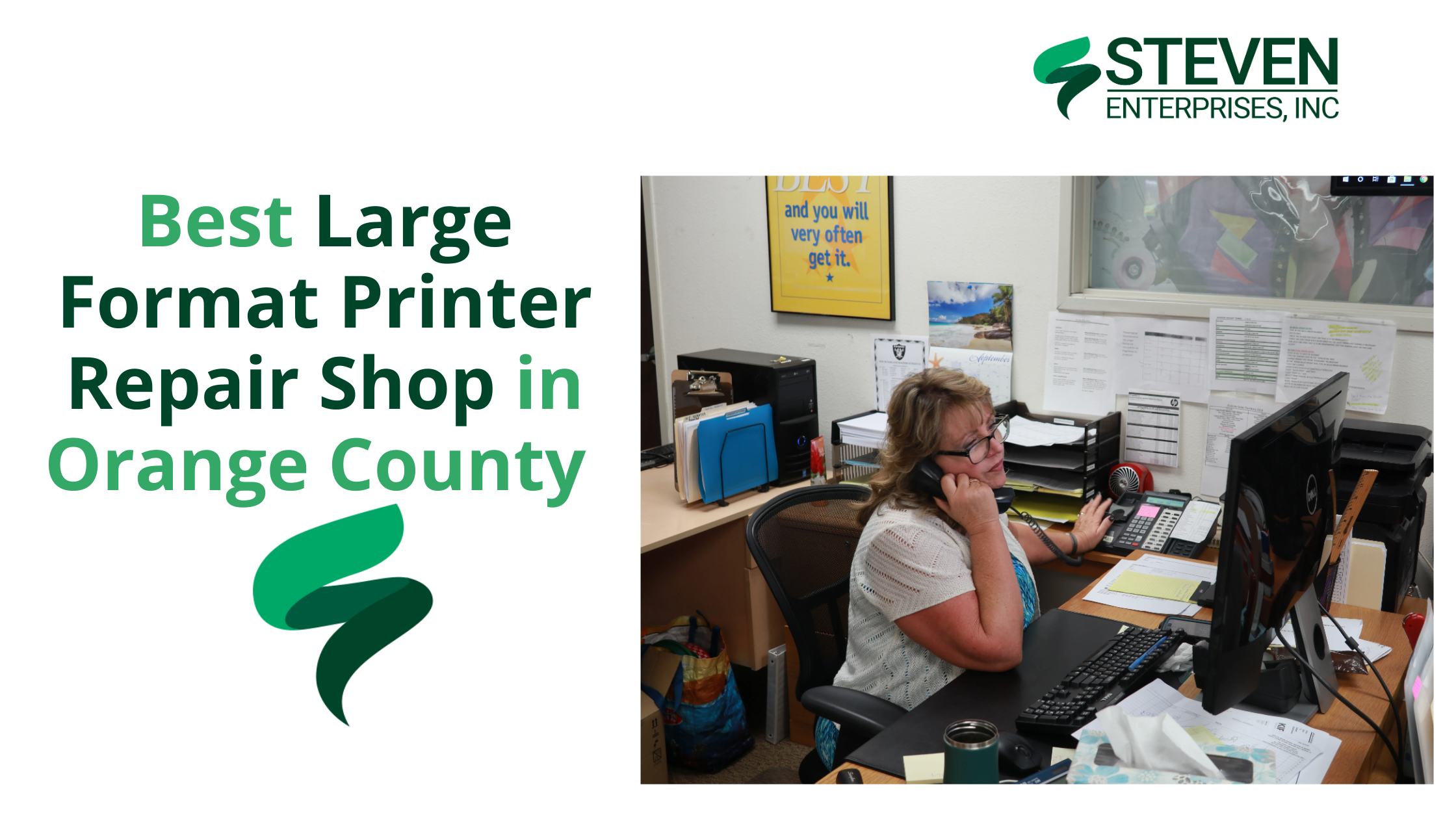
Our technicians are factory-trained and certified on multiple brands, which means we can read error codes and handle repairs on-site without needing to bring in third parties. We have direct lines to manufacturers, ensuring we get the technical support and parts needed to resolve issues quickly.
This expertise eliminates the “guesswork and delays” that come with repair shops that aren’t properly certified on your specific equipment.
Someone Always Answers the Phone
When your printer goes down, you need to talk to a real person who can help, not an automated system or voicemail. We pride ourselves on having someone who will always pick up the phone when you call.
Fast Response Times with Parts in Stock
We maintain most parts in stock and ready to ship, which means faster repairs and less downtime for your business. Our quick response times help ensure that a printer breakdown doesn’t turn into a business crisis.
Rental Units Available to Avoid Downtime
For critical situations where repairs might take time, we offer rental units to keep your operations running. This backup option ensures you never have to tell a client that their project is delayed due to equipment failure.
3 Essential Maintenance Tips to Avoid Large Format Printer Repairs
Maintaining your large format printer is crucial to ensure it runs efficiently and avoids costly repairs.
Most businesses we work with find that scheduling one annual preventative maintenance check-up is sufficient, even when using the printer at high volumes.
Here are 3 essential maintenance tips your team should follow to keep your large format printer in top condition and minimize the need for service calls.
1. Run Your Printer Every 2-4 Weeks Minimum
Regular printer use is essential, especially for inkjet models, to prevent the ink from drying out.
Why? If a printer remains idle for too long, the ink can harden, resembling a crayon-like consistency that clogs the lines and print heads, leading to significant issues.
Many businesses experienced this problem during COVID because they weren’t in the office. As a result, their printheads needed replacement, costing businesses anywhere from $80 to $500, not including the service call fee of $200 to $400.
Pro Tip: Nearly every wide-format printer stores a low-coverage “demo print.” It uses only 5–10 % ink but purges all channels. Can’t locate it? Call us at 800-491-8785 and a technician will guide you.
2. Monitor Ink Expiration Dates
Monitoring ink expiration is vital for maintaining print quality and preventing damage to your printer.
Ink typically has a shelf life of 12 to 18 months, and most printers will alert you when the ink is nearing or has passed its expiration date.
Although you might be tempted to use expired ink for a few weeks or even months, doing so can risk compromising print quality and potentially harming your printer.
It’s common practice to purchase four sets of inks at once and reorder when supplies start to run low, ensuring you always have fresh ink on hand.
PRO TIP: To keep track of expiration dates, plug your ink into your printer. The barcode will be scanned and the system will remind you when your ink is about to expire.
3. Keep Your Printer Loading Area Clean
Maintaining printer cleanliness is essential for all types of printers. For toner-based printers, it’s important to clean up residual powder regularly. Inkjet printers, while generally less messy, still benefit from regular cleaning to prevent operational issues that can lead to costly repairs.
How to Get Long-Term Use Out of Your Large Format Printer
In addition to the maintenance tips mentioned above, we always recommend our customers schedule annual preventative maintenance.
During this service, a professional large-format printing expert will flush the lines fully and run comprehensive tests on the machine to ensure every feature is functioning correctly. This maintenance is separate from software updates and requires an in-person visit.
This proactive approach helps catch potential issues before they become expensive problems that shut down your operations.
Explore Our Affordable Service Contracts at Steven Enterprises
Consider signing up for a service contract with Steven Enterprises to keep your large-format printer operating smoothly and reduce the likelihood of disruptions in your workflow.
Our contracts typically include one maintenance check per year and are often more cost-effective than paying for one-time services.
They can be paid monthly or annually, and every client is assigned an inside representative who assists with all supply needs.
For those with higher print demands, ask about our Cost Per Copy (CPC) contract to get even better rates on your supplies.
Why Orange County Businesses Choose Steven Enterprises
Regular demo prints, fresh ink, and a clean loading area go a long way—but nothing beats an expert tune-up.
We’ll answer the phone when you call—just give us a call at 800-491-8785 to speak with a large format printing expert who can help solve your printer challenges today.
Have you ever seen a roll-up banner at a trade show or a bright poster in a store window that looks almost like photo paper but tougher?
Well, there’s a good chance it was printed on matte polypropylene film.
At Steven Enterprises, we have seen increasing demand for matte polypropylene because it solves a fundamental problem.
Why settle for mediocre print quality and short lifespan when you can have exceptional results that last for decades?
Here’s a practical look at why matte polypropylene tops the “best printing substrate” list and how to choose the right material for your next project.
What is Matte Polypropylene?
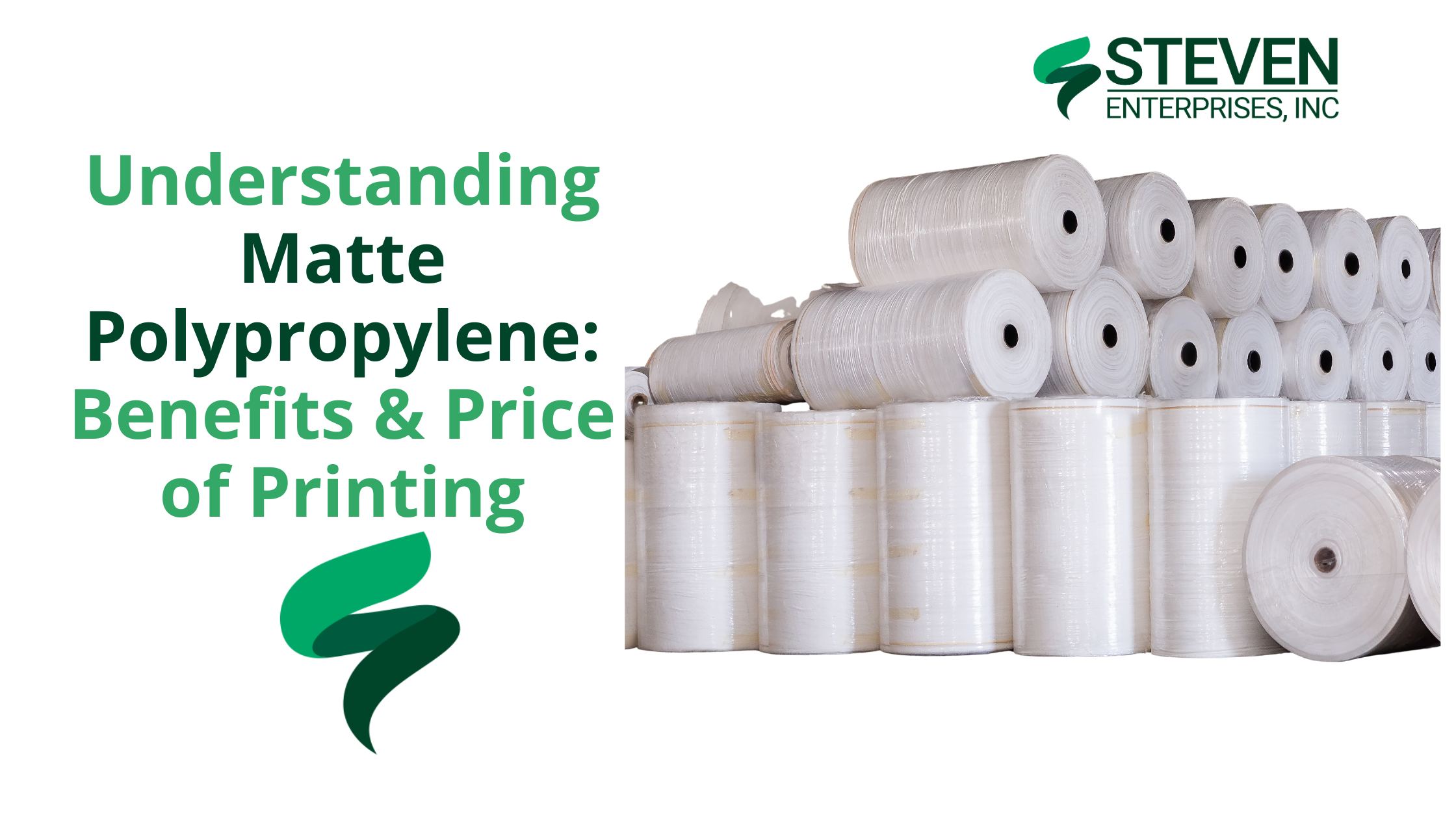
Matte polypropylene is essentially a type of plastic film – a semi-rigid thermoplastic material – that comes on rolls for use in wide-format printers. Unlike paper, polypropylene film doesn’t tear easily and can handle heavy ink coverage without curling or bleeding.
The “matte” finish means it has a non-glare surface, which is great for display readability under bright lights.
Despite being plastic-based, it often has the look and feel of a thick photo paper once printed, delivering sharp detail and rich color but with added toughness.
Simply put, matte polypropylene combines the best of both worlds. You get high-quality image reproduction like a photo or poster paper, plus the durability of a synthetic banner.
It comes in various roll widths (24″, 36″, 42″) with standard core sizes for easy printer loading.
This material works with large-format inkjet printers and supports all major ink technologies, making it compatible with most modern printers.
Benefits of Printing on Matte Polypropylene
Matte polypropylene has gained a reputation as a go-to media for many sign shops and print service providers, and for good reason. Let’s break down the key benefits:
1. Vibrant, High-Quality Print Results
One of the biggest advantages of matte polypropylene is the outstanding print quality it can deliver. The material’s coating is optimized for accepting ink, allowing for vivid colors and sharp detail.
Because the finish is matte, your prints will have reduced glare but still maintain excellent color vibrancy.
This makes the prints easy to view under various lighting conditions (for example, under harsh retail lighting or camera flash, you won’t get blinding reflections as you might with glossy posters).
According to HP’s media specifications, their matte polypropylene film produces “displays with brilliant color and high-quality images” comparable to photo-quality output. You’re essentially getting a professional, polished look that can elevate any signage or display.
2. Durable and Tear-Resistant Material
Unlike paper which can rip or crease easily, polypropylene is a resilient plastic film that resists tearing and wrinkling.
This durability makes it ideal for applications where people handle or transport the print frequently.
For example, universities and businesses often choose polypropylene for things like A-frame signs or banners precisely because it can withstand rough handling.
In practical use, you can handle polypropylene prints with confidence: roll them up for storage or shipping, mount them on foam boards, or use them in retractable banner stands without worrying about the media ripping at the edges.
If you’ve ever struggled with a paper poster tearing during installation, switching to poly film is a game-changer.
Additionally, matte polypropylene has a moderate water resistance (since it’s plastic-based).
This doesn’t mean it’s fully waterproof in all cases (the inks can still be a factor – dye inks, for instance, could run if water soaks them), but the substrate itself won’t turn to mush like paper.
3. Weather-Resistant for Short-Term Outdoor Use
Because of its durability, matte polypropylene actually holds up quite well for temporary outdoor applications.
If you need a sign or banner outside for a few days, weeks, or even a couple of months, this material can do the job without immediately fading or tearing.
Keep in mind that short-term is the key term here – while polypropylene is weather-resistant, it’s not meant to replace heavy-duty vinyl for long-term outdoor signage.
That said, if you need a sign to last all year outdoors in harsh sun, you would either laminate the polypropylene print or opt for a more robust vinyl.
But for most temporary outdoor needs – like event signage, real estate signs, construction site notices, outdoor menus, etc. – polypropylene does a fantastic job.
4. Compatible with Various Printer Ink Technologies
Whether you have a standard aqueous inkjet plotter (using dye or pigment inks), a latex printer, an eco-solvent or solvent printer, or a UV-curable (UV ink) machine, you can find a matte polyprop roll that works with it.
This is great for print providers because you don’t need special hardware to start using this material; your existing equipment likely supports it.
Aqueous Inkjet ( Dye/Pigment ) – Yes, there are polypropylene rolls with ink-receptive coatings specifically for water-based inks (often used in HP DesignJet, Canon, Epson SureColor T-series, etc.). They dry fast and give excellent results on pigment inks.
Latex – HP Latex printers can print directly on polypropylene films made for latex – the material can handle the heat of curing and results are durable.
Eco-Solvent/Solvent – There are polypropylene media products designed for solvent and eco-solvent inks (used in Mutoh printers, etc.), which adhere well and are typically very durable.
UV-Curable/UV Gel – UV printers (including UV gel like Canon Colorado series) also have compatible polypropylene films. These inks cure on the surface of the poly film, producing very robust prints.
This wide compatibility means no matter what brand or ink technology your printer uses, you can likely take advantage of matte polypropylene.
It also means if you’re a customer wanting to print something on poly, most print shops can handle it.
There’s no significant limitation like “oh you need a special machine for that”.
5. Eco-Friendly Advantages (Recyclability)
If sustainability is a concern, matte polypropylene has a couple of eco-friendly points in its favor compared to some other materials like PVC vinyl.
Polypropylene is often recyclable – many polypropylene print films can be recycled through typical plastic recycling programs after use. (Always check local recycling guidelines though, as capabilities can vary by region.)
In contrast, traditional PVC vinyl banners are notoriously difficult to recycle and usually end up in landfills, plus the PVC manufacturing process can release more harmful chemicals.
Polypropylene has a lower environmental impact in production and disposal. It’s a simpler polymer that reprocesses more readily and typically avoids the high toxic additives found in vinyl.
Polypropylene prints don’t need lamination for short-term use, saving cost and reducing plastic waste.
You can recycle your promotional posters and banner graphics after campaigns instead of creating waste.
6. Cost-Effective Printing Solution
Cost is always an important factor in choosing a print media and this is an area where matte polypropylene shines. It provides excellent value for the quality and durability you get.
Because it’s durable and water-resistant on its own, you often don’t need to laminate the prints for short-term use.
Lamination is an extra step that adds material and labor cost. With poly film, you can usually skip it and still be confident the print will endure the needed lifespan.
Skipping laminate means the final product is cheaper and produced faster.
Similarly, if you were using plain paper for a poster, you might mount it to foam board or under acrylic for rigidity.
Bottom line: If you’re watching your budget but still need professional-looking, durable prints, matte polypropylene is often the smartest choice.
Common Uses for Matte Polypropylene Prints
With numerous printing options available, selecting matte polypropylene makes sense when you need:
Superior print quality with brilliant colors
Long-term display permanence (50+ years indoor)
Tear resistance and durability
Compatibility with your existing ink system
Professional appearance for critical applications
Environmentally responsible material choice
Here are some of the most common applications where this material excels:
Retail and Point-of-Sale Displays. In-store posters, hanging signs, and POP displays often use polypropylene for its photo-like quality. It can endure being up for weeks or months.
Retractable Banner Stands: Those pull-up banner stand graphics at trade shows or events are frequently printed on matte poly film. It’s thick enough to stand straight and resists curling at the edges. It survives rolling in and out many times.
Event Signage & Directional Signs. For short-term outdoor events, conferences, or campus signage, polypropylene posters are ideal. You can use them in A-frame sidewalk signs or on stakes. They’ll hold up through the event, even if it’s rainy or windy. You can roll them up and reuse them later.
Trade Show Graphics. Beyond banner stands, poly film can be used for trade show booth graphics, backdrops, or mounted displays. It travels well due to tear resistance and prints in high resolution for a professional look.
Indoor & Short-Term Outdoor Banners. Need a banner for a grand opening or a sale that’s going to last a month outdoors? Polypropylene is a great choice for a temporary banner that doesn’t need the heft of a vinyl.
Maps and Technical Prints. GIS maps, architectural renderings, or technical posters are sometimes done on matte polypropylene for durability. Engineers can pin polypropylene maps at job sites without worrying about wind damage or water damage.
The material can handle detailed line work and legends nicely and you can roll/unroll the maps multiple times.
Photographic Enlargements (short-term. For large photo prints in short-term displays like art exhibits, matte poly works well. It provides near-photographic quality that looks great throughout campaigns and handles much better than actual photo paper.
Find Your Perfect Matte Polypropylene Solution
When comparing printing materials, you’ll find matte polypropylene often gives you the “best bang for your buck.”
But determining exactly which specifications you need for your specific project requires expert guidance.
As authorized dealers and experts in wide-format printing, we can guide you on the ideal media for your needs. We also provide quotes on rolls of matte polypropylene or any equipment that will start your project.
IT firms across the country are discovering a lucrative revenue stream that’s hiding in plain sight: reselling wide format printers to their Architecture, Engineering, and Construction (AEC) clients.
At Steven Enterprises, we have seen forward-thinking IT firms build steady income simply by guiding their AEC accounts through printer selection, network integration, and ongoing support.
Providing IT services to AEC businesses and haven’t explored this opportunity yet?
You’re missing out on significant additional income while your competitors are already capitalizing on this natural extension of IT services.
Here’s why wide-format printer sales are earning a place in the modern IT service stack and how to decide if this revenue channel belongs in yours.
Why IT Firms Are Perfect for Wide Format Printer Sales
As an IT professional, you are uniquely positioned to recommend and manage wide format printing solutions because you already understand your clients’ networks, security requirements, and operational needs.
When AEC businesses need large format printing capabilities, they naturally turn to their trusted IT partners for guidance.
The relationship makes perfect sense.
You are already managing their technology infrastructure, so adding printing solutions creates a seamless extension of your existing services while providing substantial additional revenue.
What Additional Income Streams Work Best for IT Firms?
Wide format printer reselling offers IT firms multiple revenue opportunities like:
Initial equipment sales with competitive margins
Network setup and integration services (your core expertise)
Ongoing maintenance and support contracts
Security monitoring and updates
User training and workflow optimization
Consumables and supplies management
This diversified income stream means you generate money from the initial sale and also build long-term, recurring revenue relationships.
The Strategic Advantage: Network Control and Security
When you help source and select wide format printers for your AEC clients, you gain several critical advantages:
Network Security Control: You choose machines you trust on your managed networks, eliminating potential security vulnerabilities from unknown or incompatible devices.
Brand Reliability: Leading manufacturers such as HP,KIP, and Canon all offer excellent software platforms with robust security features, providing confidence in the solutions you implement.
Ongoing Service Opportunities: Once printers are installed, you become the go-to resource for network integration, troubleshooting, security updates, and user support. This creates multiple touchpoints that strengthen your client relationships.
Which IT Service Models Work Best for Wide Format Printer Sales?
The opportunity varies based on your service model:
Large AEC companies typically have in-house IT departments that can become internal champions for your solutions
Smaller AEC firms usually rely on outsourced IT services, making you the natural point person for all technology decisions, including printing infrastructure.
Both scenarios present opportunities, but outsourced IT relationships often provide more direct influence over purchasing decisions.
Why are AEC Businesses Ideal Clients for This Service?
Architecture, Engineering, and Construction firms have unique printing needs that require specialized knowledge:
Large format technical drawings and blueprints
High-volume document processing
Color accuracy for presentations and marketing materials
Network integration with existing CAD and project management systems
Security requirements for sensitive project data
Your existing relationship and technical expertise make you the ideal consultant for these specialized requirements.
How Does IT Involvement Improve Printing Security for Clients?
When you manage wide format printer selection and implementation, you provide significant security benefits to your AEC clients:
Risk Mitigation: You can evaluate and implement proper security protocols from day one, thereby preventing potential data breaches through the use of unsecured printing devices.
Network Integration: A professional setup ensures that printers are properly configured within existing security frameworks, rather than creating vulnerable access points.
Ongoing Monitoring: Your continued involvement means security updates and monitoring become part of your managed services offering.
What Cost Savings Can IT Firms Demonstrate to AEC Clients?
Beyond security benefits, you can show clients tangible cost savings:
Reduced downtime through proper network integration and ongoing support
Optimized printing workflows that improve productivity
Bulk purchasing power when you manage equipment procurement
Preventive maintenance that extends equipment life and reduces emergency service calls
How We Help IT Firms Succeed in Wide Format Sales
Expert Equipment Selection
Our team helps you select the machines that are best suited for your clients’ specific needs, taking into account their volume requirements, security standards, and integration needs.
Security Deep-Dive Analysis
We’ll provide you with detailed comparisons of security features across different brands (HP, KIP, Canon), giving you the technical knowledge to make informed recommendations and articulate security benefits to your clients.
Client Implementation Support
Steven Enterprises helps you pitch your clients by providing materials that clearly demonstrate the value proposition: cost savings for them combined with risk removal for potential security breaches.
We also handle all the technical legwork for your client relationship, making you more valuable as their trusted IT advisor while ensuring seamless implementation.
Are Other IT Firms Reselling Wide Format Printers?
IT firms across the country are already capitalizing on this opportunity. From coast to coast, smart IT professionals have recognized that wide format printer sales and management represent a natural evolution of their service offerings.
The trend is clear and in favor of IT service providers that deliver print services as part of a broader offering.
Companies are asking their IT partners to “find a printer” because they trust their technical judgment and want integrated solutions.
What Happens If You Don’t Adapt?
If you’re not offering wide format printing solutions to your AEC clients, you’re likely missing revenue opportunities while competitors position themselves as more comprehensive technology partners.
The businesses that provide complete technology solutions—including printing infrastructure—become more valuable and harder to replace than those offering only traditional IT services.
Getting Started with Wide Format Printer Sales
Starting your wide format printer sales program doesn’t require massive upfront investment or extensive training.
The key is maximizing your existing client relationships and technical expertise while partnering with experienced suppliers who can provide the specialized knowledge you need.
What Support Do You Need to Succeed?
Successful IT firms in this space rely on knowledgeable partners who can:
Provide technical specifications and comparisons
Offer competitive pricing and terms
Handle complex client questions about printing workflows
Support implementation and ongoing service needs
Keep you updated on new technologies and security features
Add Wide Format Printers to Your IT Service Portfolio
The opportunity to boost your revenue while providing additional value to your AEC clients is significant, but success requires the right partnership and approach.
Let us help you build this lucrative service offering while strengthening your client relationships.
Call 800-491-8785 or reach out through our contact form to discuss how we can help you capitalize on the wide format printing opportunity in your market.
We’ll help you do all the legwork for your clients, positioning you as their complete technology solution provider while building a profitable new revenue stream for your business.
When searching for the best office copiers to invest in for 2025, one brand consistently rises above the competition: Toshiba.
Toshiba’s e-Studio multifunction copiers have quietly become the gold standard for busy offices.
At Steven Enterprises, we have seen increasing demand for Toshiba office copiers because they solve a fundamental problem: why pay for features you don’t need while missing the ones you do?
Here’s a practical look at why Toshiba tops the “best office copier” list this year and how to choose the right model for your workflow.
What Makes Toshiba Office Copiers Different from Desktop Printers?
Office copiers are the large, professional-grade machines you see in print rooms and busy offices—not the small desktop printers you might have at home.
These are designed for multiple users and high-volume printing, with speeds ranging from 25 pages per minute up to 90 pages per minute.
Unlike desktop printers that handle basic printing tasks, Toshiba office copiers are built for businesses that need to “crank out documents” efficiently while maintaining professional quality.
They’re designed for offices where multiple people need reliable access to advanced printing, scanning, and finishing capabilities.
Why Choose Toshiba Office Copiers Over Competitors?
Toshiba has built a reputation for manufacturing office copiers that deliver exceptional quality and reliability.
What sets Toshiba apart is its completely customizable approach that lets you get everything you want without paying for features you don’t need.
Unlike one-size-fits-all solutions, Toshiba e-Studio copiers work on a modular system. You start with a standard two-drawer copier with a scanner, then add features piece by piece based on your specific business needs.
As we like to tell our customers, “You can add four drawers, finishers, staple finishers, three-hole punch, fax… You name it.”
Toshiba’s reputation for quality and reliability makes it a preferred choice for businesses that can’t afford downtime.
Whether you’re running a busy print shop or managing an office that processes high volumes of documents daily, Toshiba copiers are designed to consistently handle demanding environments.
Key Specifications That Determine Your Perfect Toshiba Copier
Speed: The Primary Price Factor
Speed is the most significant factor determining copier cost. Toshiba’s intuitive naming convention makes this easy to understand—an “e-Studio 2520AC” prints 25 pages per minute (ppm), while an “e-Studio 3525AC” handles 35 ppm.
The faster the machine, the higher the price, but this direct correlation helps you match your budget to your actual throughput needs.
Print Quality (DPI) for Professional Results
Toshiba office copiers deliver up to 1200 x 1200 DPI (dots per inch), ensuring crisp, professional-quality prints for all your business documents.
This high resolution is particularly important for businesses that need “really good quality prints” for client presentations, technical drawings, or marketing materials.
Paper Size Flexibility
These machines handle various paper sizes, from standard 8.5 x 14 inches up to 11 x 17 inches, accommodating everything from letters to larger format documents.
This flexibility removes the need for multiple devices and streamlines your document workflow.
Color vs. Monochrome: Cost-Effective Choices
The main difference between color copiers and monochrome copier models is cost. Choose based on whether your business regularly requires color printing or if black and white will suffice for your daily operations.
Advanced Features That Set Toshiba Apart
Professional offices often require capabilities beyond basic printing:
Three-hole punch for documents going into binders
Booklet finishing for creating professional marketing materials
Saddle stitching for binding books and booklets (staples on the inner fold to create small books)
Double-sided printing and scanning for efficient paper usage
Staple finishers for multi-page documents
Can You Add Features After Purchase?
Yes! One of Toshiba’s biggest advantages is expandability. You can add finishers, three-hole punch capabilities, staple finishers, and even fax modules later (though “most people don’t fax anymore since everyone scans and emails”). This flexibility allows you to start with basic functionality and upgrade as your business expands.
Important note: While you can add features later, there are no trade-in options for upgrading to completely different models, so it’s essential to plan your feature needs carefully from the start.
Who Benefits Most from Toshiba Office Copiers?
Any business with an office environment benefits from Toshiba copiers. This includes:
General offices that need reliable daily printing and scanning for “people who are printing a lot”
Print shops that create booklets and marketing materials on demand for customers
Businesses attending conferences that need professional booklets and handouts
Any company prioritizing double-sided printing, scanning, and document quality
How IT Firms Benefit from Recommending Toshiba Copiers
IT professionals increasingly handle printer purchasing decisions because “they want machines they trust on their network.”
Toshiba’s reliable software and strong security features make it a preferred choice for IT departments managing office equipment.
As digital transformation continues, IT professionals appreciate having control over devices that integrate seamlessly with existing network infrastructure.
Toshiba Office Copier Pricing: Investment That Makes Sense
Pricing for Toshiba office copiers typically ranges from $5,000 to $50,000, depending on speed, features, and customization options.
This wide range reflects the modular nature—you only pay for what you need. The faster the machine and the more features you add, the higher the price.
However, this customizable approach often results in better value than purchasing an over-featured machine with capabilities you’ll never use.
The pricing structure eliminates the “legwork for nothing” that comes with machines that don’t match your actual needs.
Choosing the Right Toshiba Copier for Your Business
With numerous options and configurations available, selecting the ideal Toshiba office copier can be overwhelming.
Why focus on office copiers instead of desktop models?
While Toshiba manufactures various printing solutions, focusing on office copiers makes the most business sense.
Desktop models typically offer lower margins and require more effort for less return—essentially “more legwork for nothing.” Office copiers provide better value propositions for both buyers and sellers.
Find Your Ideal Toshiba Office Copier with Us
The wide range of options and customization possibilities means there’s a Toshiba e-Studio copier perfect for your business. But determining exactly which configuration you need requires expert guidance.
Our team will help you find the right Toshiba office copier solution tailored to your specific business needs and budget, so you get maximum value without paying for unnecessary features.
Don’t wait. Call 800-491-8785 or complete our contact form to receive a personalized analysis of your printing needs and a custom Toshiba e-Studio configuration tailored to your business’s growth.
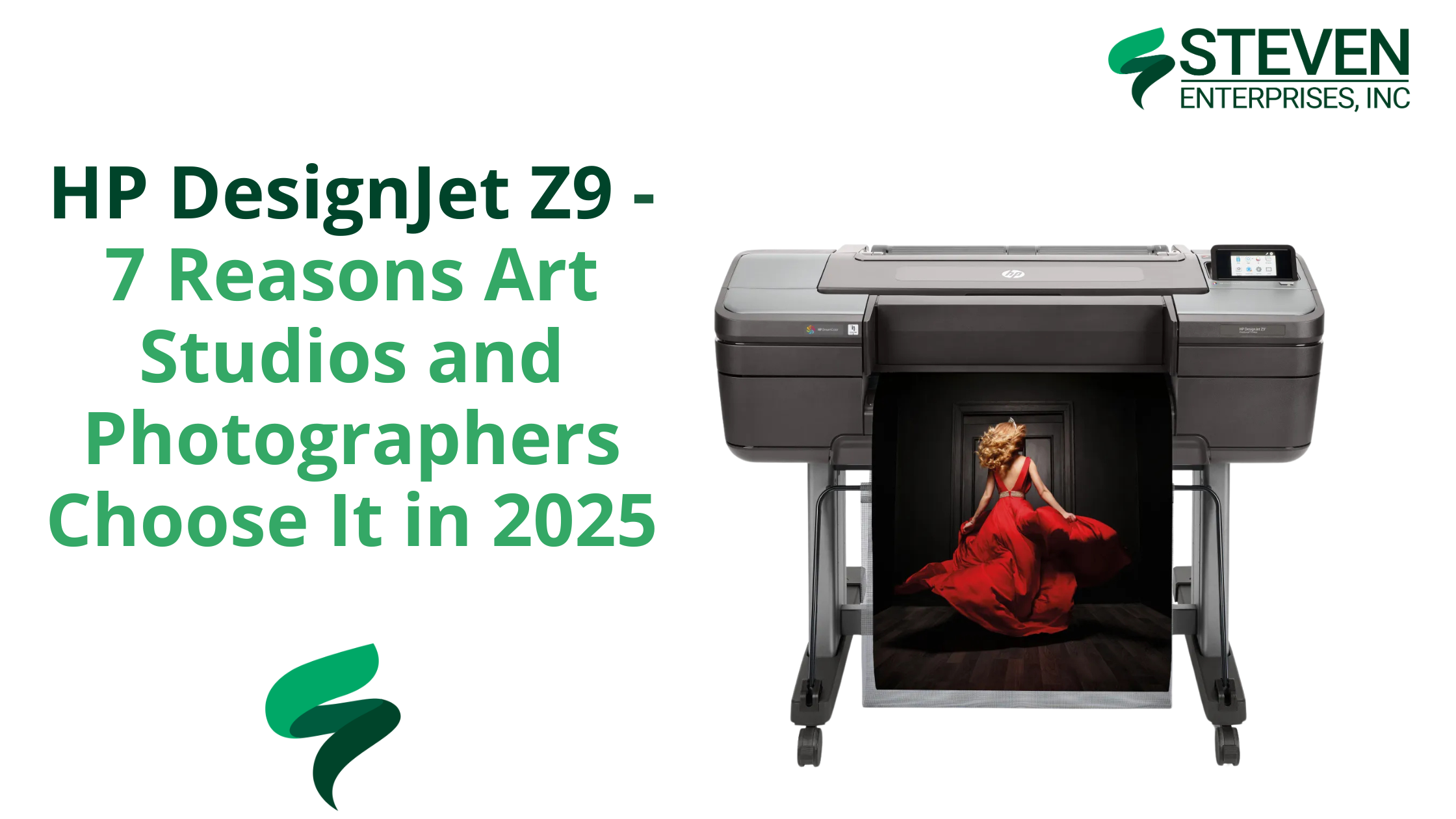
When it comes to art and photography, the bar for print quality keeps rising. Studios aren’t just printing posters—they’re reproducing emotion, detail, and expression.
In 2025, that means choosing a printer that can capture it all with uncompromising accuracy. That printer is the HP DesignJet Z9.
While general-purpose wide format printers like the HP DesignJet Z6 are great for signage and school posters, art and photo professionals need more.
At Steven Enterprises, we understand the unique needs of movie studios, art directors, photographers, and creative professionals.
The Z9 offers expanded color precision, workflow efficiency, and media handling designed specifically for gallery-quality output.
Top 7 Reasons Why Art Studios Should Get the HP Z9 Large Format Printer
1. Expanded Color Gamut with 9 Inks
The HP Z9 uses a 9-color ink system, giving you a much broader and richer color spectrum than the 6-ink HP Z6. It includes chromatic red, green, and blue, plus dual blacks, enabling smooth gradations and more lifelike skin tones, shadows, and highlights.
For photographers, that means more depth. For artists, it means closer reproduction to the original. If your work lives and dies by accurate color, this printer delivers.
Whether you’re capturing skin tones or museum-worthy pigment transitions, the Z9 ensures what’s on paper matches what’s in your mind.
2. Gloss Enhancer for Professional Finish
The HP Gloss Enhancer kit (compatible with select media types) adds a uniform, lab-quality sheen across your entire print. This eliminates common problems like bronzing and inconsistent finishes, especially on glossy or satin photo papers.
For photographers, this means your blacks stay deep, and your highlights stay clean. For artists, it’s a professional finish without added sprays or coatings.
3. Dual Roll with Auto-Switching
Artists and studios rarely stick to one medium. With dual roll support and automatic switching, the Z9 lets you load two different roll types or sizes, such as canvas and fine art paper, and effortlessly switch between them based on job requirements.
It’s a game-changer for productivity, especially in fast-paced environments where multiple projects are underway.
4. Built-In Vertical Trimmer
Tired of trimming prints by hand? The Z9’s built-in vertical trimmer cleanly slices the sides of your prints, giving you clean, exhibition-ready edges every time.
This is especially valuable for print shops or studios selling ready-to-frame artwork or running short-run production. Fewer manual steps, straighter edges, and more time for creative work.
5. Faster Printing Without Quality Loss
The HP Z9 is designed to print faster than its predecessor, the HP Z6—up to 2.5x faster—without compromising on resolution or detail.
Thanks to 2400-nozzle-per-inch printheads and HP Pixel Control, your large files (think 300dpi gallery posters) render cleanly and quickly. This makes batch printing efficient, even under tight deadlines.
6. High-Capacity 1-Liter Eco-Carton Cartridges
The Z9 supports 1-liter ink cartridges, so you’ll get more prints before needing replacements. For studios printing large formats or high volumes, this significantly reduces interruptions and lowers ink costs per job.
Better yet, the Eco-Carton design cuts plastic waste by using recyclable cardboard-based containers—ideal if your studio is aiming for greener practices.
7. Spindle-Less Roll Loading for Convenience
Older printers often require spindles to load new media rolls—a slow, frustrating process. The spindle-less roll system on the Z9 lets you simply drop in a new roll and lock it into place.
One of those underrated time-savers keeps your team focused on the creative process, not media setup.
Z9 vs Z9 Pro: Which One Is Right for Your Studio?
TheHP DesignJet Z9 supports prints up to 44 inches wide, which is more than enough for most artists, photographers, and galleries.
If you regularly produce oversized installations or panoramic works, consider theZ9 Pro, which offers up to 54-inch width capacity and a slightly more robust build for production environments.
Both models offer the same color fidelity and feature set; the “Pro” simply extends your physical print size and handles heavier usage.
Z9 vs Z6: Why Studios Need More Than 6 Inks
While theHP DesignJet Z6 is excellent for posters, wayfinding signs, or general graphics, its 6-ink configuration isn’t built for artwork.
Need a full color spectrum with gallery-quality tonal range? The Z9’s added inks—and gloss enhancer—make all the difference.
Looking for something even more advanced? TheHP Z6 Pro offers enhanced speed and processing for GIS and technical applications, but the Z9 remains the clear choice for photography and art.
The Creative Professionals Who Rely on the HP Z9
The HP DesignJet Z9 is a powerful production partner for creatives who demand precision, vibrancy, and reliability in every print.
Here’s how different professionals are using the Z9 to elevate their work:
Art Studios producing giclée and archival reproductions:. Thanks to its 9-ink system and gloss enhancer, the Z9 can capture every nuance—whether it’s the textured brushwork of an oil painting or the delicate hues of a watercolor.
Professional photographers delivering gallery-quality prints: The Z9 ensures that skin tones, shadow details, and vibrant landscapes are printed exactly as they appear on screen, without the need for constant recalibration.
Marketing agencies crafting high-impact visual campaigns: The Z9 brings concepts to life with rich color depth and edge-to-edge sharpness. Teams can print oversized visuals, proof designs in-house, and rapidly adjust campaigns without waiting on outside vendors.
Museums and galleries managing exhibitions in-house: Curators and exhibit designers use the Z9 to print high-resolution artwork reproductions, title panels, and educational materials with museum-grade quality.
Print shops offering premium services to creatives: Boutique print providers choose the Z9 to offer a higher tier of service to artists, photographers, and designers.
Ready to Elevate Your Prints with the HP Z9?
As creative professionals push for sharper, deeper, and more accurate visual output, the HP DesignJet Z9 has proven itself as a top-tier choice for bringing ideas to life.
With demand for high-resolution content on the rise, the tools you use to produce it matter more than ever.
In 2025, print volumes are declining across many industries due to widespread digitization.
Government offices and municipalities, for example, are shifting paperwork online and printing far less than before.
With fewer “must-print” pages, buyers in 2025 are prioritizing lower-volume, lower-foot-print devices that still deliver professional speed and security.
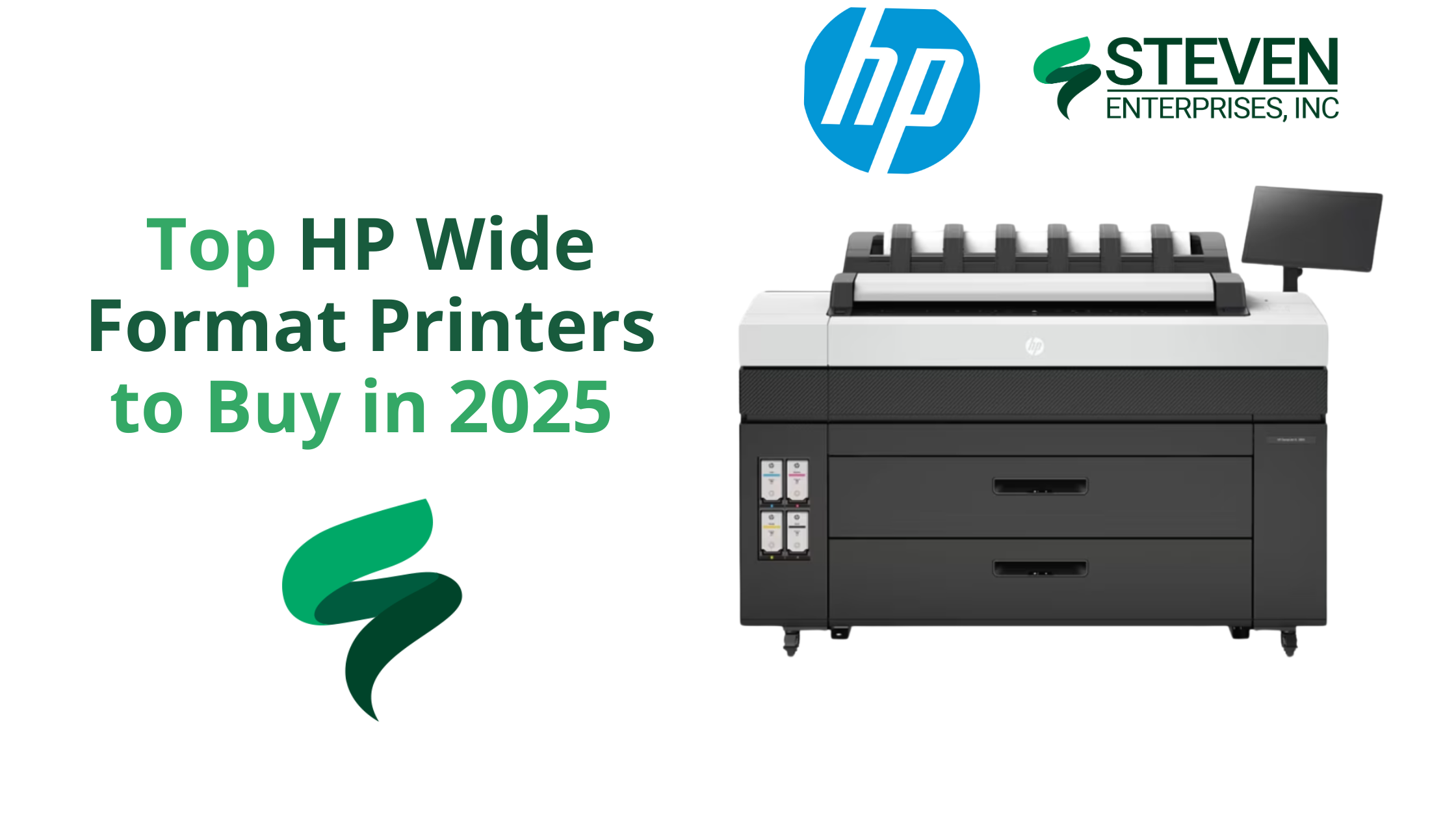
At Steven Enterprises, the five HP wide format printers below are the ones our clients ask for most, organized from highest to moderate volume.
Each blends productivity with a lean cost profile that suits today’s hybrid workflows.
The HP DesignJet XL 3800 is the fastest color printer in its class, making it ideal for architecture, engineering, and construction (AEC) professionals who need quick turnaround on large-format prints.
This 36-inch multifunction printer (MFP) produces color and monochrome drawings with exceptional quality, so offices can consolidate into one device for all wide-format needs. It’s designed to keep busy project teams moving efficiently with minimal downtime.
Why Purchase the HP DesignJet XL 3800:
Blazing Speed: Delivers up to 6 D/A1-size prints per minute, so large CAD sets or GIS maps are ready in moments. The first page out is as fast as 20 seconds, meaning no long warm-up waits.
High Print Quality: Produces excellent line accuracy for CAD drawings and vivid colors for graphics.
Integrated Scanner & Workflow: As an MFP, it offers easy one-click copying and scanning from the 15-inch touchscreen panel. This simplifies document workflows by letting you scan markups or copies directly.
Top-Tier Security: Protects your network and data with HP’s advanced security features. In fact, HP touts it as “the world’s most secure large-format printer,” with secure boot, user authentication, and other safeguards built in.
Space-Saving Design: Despite its capability, the XL 3800 has a compact footprint about 20% smaller than previous generation models. This gives you extra workspace and flexibility in smaller offices.
The HP DesignJet XL 3600 is a dependable wide-format MFP built for consistent output in environments that don’t require extremely high print volumes. Its reputation for reliability and low operating costs makes it a go-to choice for offices that value simplicity, efficiency, and steady performance.
It is often praised as “immediate and reliable” – it simply works whenever needed. This printer is an excellent choice for organizations that value low operating costs and dependability over sheer speed.
It’s particularly well-suited to offices that print a mix of technical documents and need them done right every time.
Why Purchase the HP DesignJet XL 3600:
Quick First Print: The HP DesignJet XL 3600 delivers the fastest first-page-out in its class—just 29 seconds for a D-size print—so your team can grab documents on demand and keep projects moving without delays.
Low Running Costs: Built for efficiency, the XL 3600 uses less energy and features long-life components to minimize maintenance and lower your total cost of ownership over time.
Large Touchscreen & Ease of Use: A generous 15.6-inch touchscreen panel gives easy access to features. Users can print directly from personal or shared network folders and use HP Click software for efficient batch PDF printing.
Quiet, Office-Friendly Design: This model has a compact, 30% smaller footprint and quiet operation to fit comfortably in office settings.
Rock-Solid Reliability: The XL 3600’s robust design easily handles demanding environments. Features like automatic print stacking (up to 100 pages) and auto media loading make printing hassle-free.
The HP DesignJet XT 950is purpose-built for teams that juggle both large-format and smaller-size prints on a daily basis.
This dual-format flexibility makes it a perfect fit for AEC, GIS, and design offices where switching between full-size plans and reduced check prints is routine.
Why Purchase the HP DesignJet XT 950 Wide Format Printer:
Dual-Format Printing: The XT 950 has an integrated input tray for up to 100 half-size sheets (Letter, Tabloid, or A3/B) and an output sorter, allowing mixed-size print jobs in one go.
Productive Speed: It prints a D-size page in ~21 seconds (up to 90 D-size prints per hour), which is faster than most competitors in its class. This keeps project workflows moving, even when you have many pages to get through.
High Image Quality: HP’s pigment-based Flex Tech Inks ensure high-quality output for both line drawings and graphics. Technical line work comes out sharp and fine details in renders or maps are clear, with ink that resists smudging and water.
Simplified Workflow:HP Click software support means you can send multiple files (even a mix of sizes) to print in just a few clicks with a real-print preview.
The HP DesignJet T1600 is a 36-inch plotter that offers high-end precision and advanced workflow features for technical and graphics printing.
It’s popular among design firms and departments that require sharp detail and robust performance but don’t quite need the ultra-high speed of an XL series.
The T1600 stands out for its easy PDF printing capabilities and professional output stacking.
Why Purchase the HP DesignJet T1600:
Superior Print Accuracy: With six inks (including gray and photo black), the T1600 produces fine line detail and smooth color gradients ideal for CAD drawings, architectural renderings, and posters. It faithfully reproduces complex schematics and color-critical visuals.
Fast Throughput: This model can print up to 180 D-size prints per hour (in fast mode). That’s about 3 D-size sheets per minute, enough speed to meet tight deadlines on large drawing sets. It also supports dual-roll configurations, so you can load two different media types or sizes and switch automatically.
Easiest PDF Printing: The T1600 features the Adobe PDF Print Engine, allowing it to process complex PDF files natively and accurately. You can send multi-page PDFs directly to print, and with HP Click software, batch printing becomes faster and more streamlined than ever.
100-Page Stacking Tray: One standout feature is the integrated output stacker that neatly collates up to 100 sheets. Prints stack neatly and come out flat, eliminating the mess of scattered pages. This feature is valuable when you’re producing large sets like construction plans or GIS map series.
Quiet and Secure Operation: The T1600 is designed for the office – it operates quietly and includes the sameHP Wolf Security features for network protection and user access control as other modern HP models.
Rounding out our list is the HP DesignJet T850, a compact large-format printer built for CAD drawings, maps, and rendering outputs in small offices or remote job sites.
The HP DesignJet T850 proves that even as printing becomes less frequent, having a dependable in-house printer is still a smart move.
It gives architects, engineers, and GIS specialists a convenient way to produce high-quality large-format prints only when needed, without overspending on a bigger machine.
Why Purchase the HP DesignJet T850 Wide Format Printer:
Space-Saving, Modern Design: Notably, the T850’s compact 36-inch design seamlessly includes an integrated 50-sheet A3/A4 tray. Thus, it prints half-size sets effortlessly without manual paper switches.
Capable Performance: Despite its size, the T850 swiftly outputs D-size drawings in 25 seconds, approximately 90 per hour. Hence, it suits low to mid-volume CAD or poster printing.
Excellent Ink Efficiency: Specifically, its pigment-based inks consistently ensure durable, crisp lines and vibrant fills. Moreover, efficient ink use significantly lowers print costs.
Mobile and Secure Printing: Similarly, the T850 supports HP Smart app printing, allowing mobile job management. Additionally, HP Wolf Security effectively protects data
Optimize Your Print Workflow with an HP Wide Format Printer
As processes go digital, investing in a quality wide-format printer still remains essential for many businesses in 2025 and beyond.
Moreover, the right printer enables you to consistently produce critical, high-quality documents, plans, and presentations as needed.
Not sure which HP wide format printer is right for your organization? Let our team guide you to the right fit. Call 800-491-8785 or fill out this contact form for a personalized sizing analysis. We will help you choose a solution that keeps your work moving and your overhead lean.
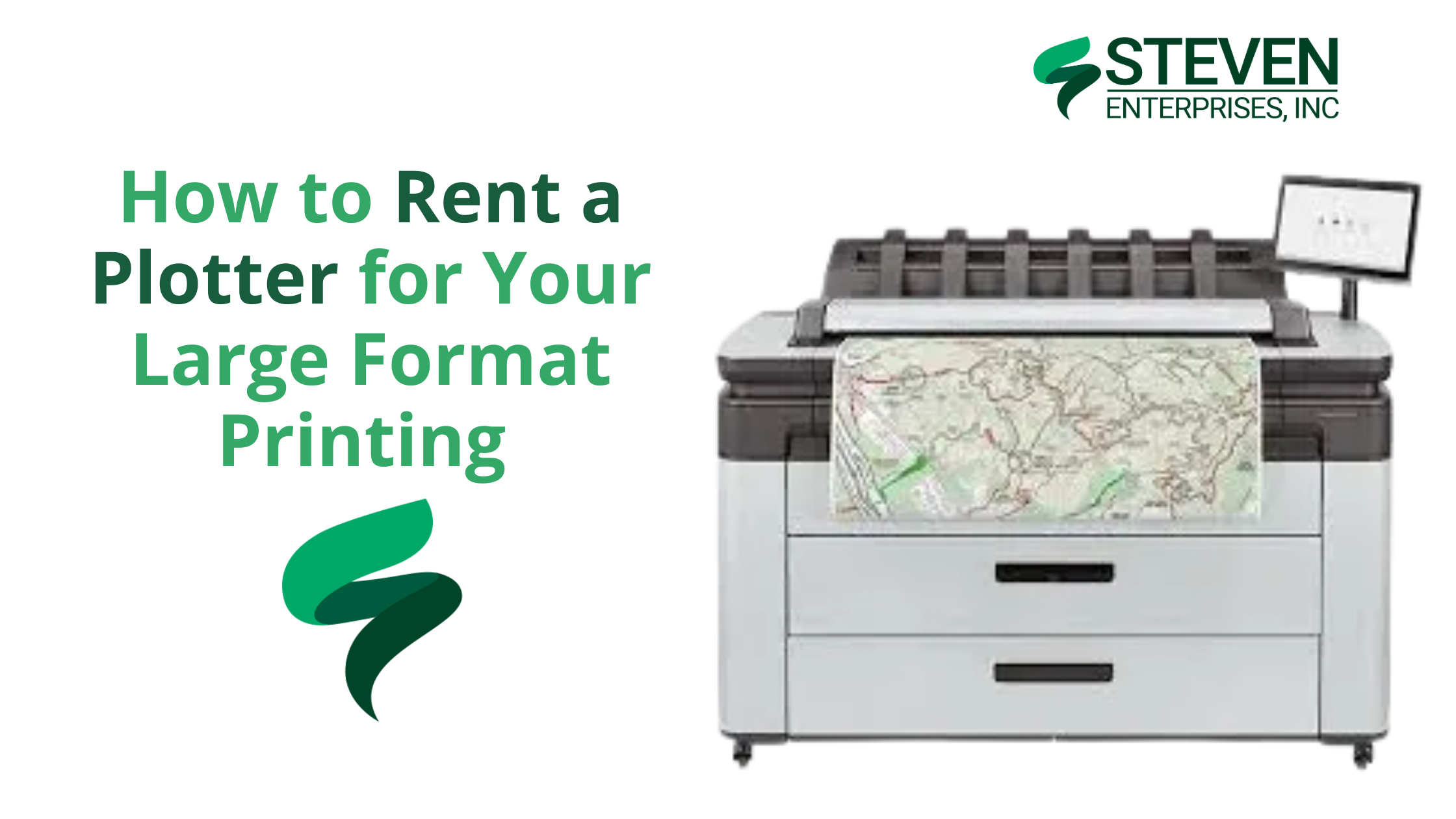
When you need a large-format printer for only a few months, such as for a film shoot, job site trailer, or special event, purchasing outright can feel like overkill.
Renting a plotter solves that dilemma by giving you professional-grade printing capabilities without the long-term costs and responsibilities of ownership.
At Steven Enterprises, we have helped organizations across industries manage short-term printing needs through flexible rental plans, on-site setup, and comprehensive support.
Let’s investigate why you should rent a plotter rather than buy one.
Who Should Rent a Plotter?
1. Movie & TV Production Studios
Film and TV productions often require on-set printing for set designs, location layouts, and promotional materials.
Because each show’s shooting schedule might last anywhere from a few weeks to several months, renting a plotter allows studios to scale up or down without paying for a device they may not use after production wraps.
Case in Point: A streaming studio needed a wide-format solution for a 6-month pilot series. By renting an HP Z9 from Steven Enterprises, they printed 500+ large-format designs — everything from storyboards to promotional posters — and saved roughly $22,000 over buying a new device or outsourcing. Once the show was green-lit for Season 2, they confidently purchased the Z9 outright, proving its value and reliability.
2. Construction & Engineering Teams
Many construction and engineering projects happen at temporary job sites lasting just a few months. Quick access to large-format blueprints, permits, and as-builts can save critical time and keep projects moving forward.
When the project ends, you don’t have to store or resell the equipment you used. Simply return it, and you’re done — no ongoing maintenance or depreciation to manage.
3. Event Planners & Trade Shows
One-time or seasonal events—such as trade shows, festivals, or holiday promotions—often demand vibrant banners, directional signage, and floor plans on a tight deadline. Owning a plotter that sits idle for most of the year isn’t cost-effective.
Rent a wide-format printer for the duration of your event schedule. Afterward, return the machine and eliminate the headaches of storage or maintenance.
Plotter Models Available for Rent
Beyond the popular HP Z6 and HP Z9 for large-format color printing, we also offer additional HP plotter models that provide scanning, dual-roll printing, and high-speed output.
30% smaller footprint and quieter operation compared to similar devices
Fast 30-second first page out
Automated scanning and post-editing features for quick markups
Best For: Fast-paced environments that require both color and monochrome prints at high speed. It’s also great for engineering teams that regularly need to revise plans or create detailed technical documents.
What Do You Get with Your Plotter Rental?
Depending on the model and configuration, purchasing a new wide-format printer can easily cost $8,000–$20,000.
Renting lets you pay a predictable monthly rate (often $325–$400) and invest your capital elsewhere. When you rent a plotter from Steven Enterprises, you get a complete, worry-free printing solution that includes:
Full On-Site Setup & Installation: We’ll deliver the machine to your location, set it up, and walk you through the fundamentals — from loading paper and inks to performing basic troubleshooting.
Ongoing Service & Support: If there’s a malfunction, our certified technicians will come on-site to fix it at no extra charge — unlike owning a printer, where post-warranty repairs are out-of-pocket. If persistent issues arise, we can swap the plotter so you’re not left waiting for lengthy repairs.
Flexible Rental Terms: Whether you need the device for two months, six months, or a year, we tailor the rental period to match your project timeline. When your job is done, simply return the plotter. If your printing needs change, you can upgrade to a different model without the hassle of selling or replacing owned equipment.
User Training: We’ll train your team on tasks like loading media, installing ink cartridges, and clearing paper jams.This will reduce downtime and maximize the value of your rental.
Note:Paper and ink are not included in the monthly fee. However, we can supply them at competitive rates, or you can purchase these supplies from your preferred vendor.
Explore a Plotter Rental for Your Next Project
With Steven Enterprises, you can focus on your project’s success, not the overhead of printer ownership. Whether you’re managing a movie set, running a construction site, or planning a one-time event, our HP plotter rentals make it easy to produce professional documents and graphics on demand.
Call us now at (800) 491-8785 to discuss pricing, model availability, and rental terms or request a custom quote via our website. We’ll match you with the ideal Plotter and set up flexible rental terms tailored to your needs.
Get a Free Consult with a Printing Expert
Book a consultation with a certified printing expert to discuss your large format printing needs.











 Expert Equipment Selection