Renting vs. Buying a Large Format Printer: A Cost Breakdown
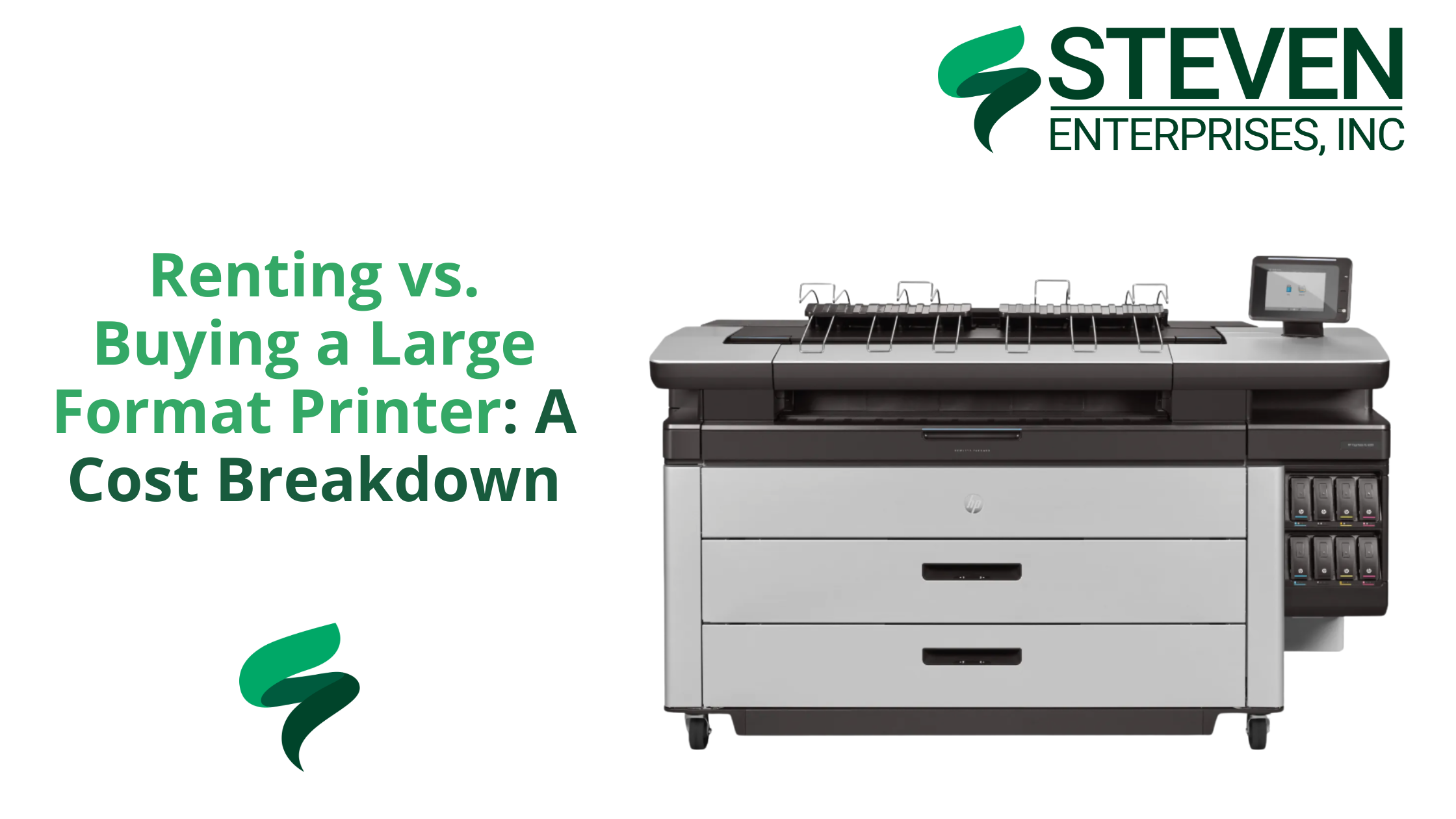
Wondering whether you should rent a large format printer, lease it or buy it? Yeah you’re not the first.
The right call depends on your project timeline, your print volume, and whether the machine needs to move between sites.
At Steven Enterprises, we hear this question from construction teams, production studios, and event planners alike, and the math works the same way no matter the industry.
We rent, lease, and sell wide format printers, so we’ll walk you through real numbers and let you decide what fits.
When Should You Rent, Lease, or Buy a Large Format Printer?
There’s no single right answer here, but your timeline gets you most of the way there. A few general rules of thumb:
- 3 to 6 months: rent. You pay a flat monthly rate, return the machine when the project wraps, and you’re done. No long-term commitment and no leftover printer to store or sell.
- 6 months to 2 years or longer: lease or buy. Past this point, rental costs start to exceed the machine’s value. Owning or leasing gives you better monthly value while keeping the equipment working for you long term.
If you’re somewhere in the middle and unsure how long the job will run, renting first and revisiting the decision later is a reasonable approach. Project timelines shift, and flexibility has real value.
What It Costs to Rent a Large Format Printer
Rental pricing at Steven Enterprises typically runs $300 to $400 per month for the machine itself, depending on the model, plus your own paper and ink supplies.
We can supply and ship those quickly through your account manager, and the cost depends on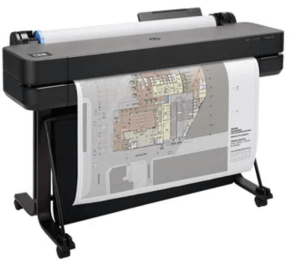
your project, which we’re happy to estimate during the rental process.
A few of the models available for rent:
- HP DesignJet T630 MFP: A 36-inch printer without a built-in scanner, a solid fit if you only need to print and don’t need scanning on-site.
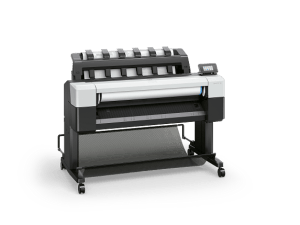
- HP DesignJet T2600 MFP: A 36-inch multifunction unit with an integrated scanner. Along with the T630, this is one of our most common rentals across construction sites and film and TV production, and we keep around 20 of these two models combined in the field at any given time.
- HP DesignJet XL 3600 MFP: A step up in throughput, also a 36-inch multifunction with a scanner.
- Canon Series: Available for rental only, for job-specific rental needs we don’t sell outright.
Most of our rental units print and scan, with the T630 MFP being the exception as a print-only model. On a job site or production set where you need to scan redlines or existing drawings alongside printing updated documents, that distinction matters, so let us know your scanning needs when you request a quote. See some of our rental options here.
Who Rents a Large Format Printer, and Why
Construction teams, film and TV productions, and event planners are the three groups most likely to benefit from renting a large format printer. And this is because each deals with temporary job sites and short-term print demand.
Construction & Engineering Teams
Construction and engineering projects often run at temporary job sites for just a few months at a time. Quick access to blueprints, permits, and as-builts on-site can save real time and keep a project moving. 
When the job wraps, you don’t have to store or resell anything. You simply return the machine, with no ongoing maintenance or depreciation to manage.
Film & TV Production Studios
Film and TV productions often need on-set printing for set designs, location layouts, and promotional materials.
Since a shooting schedule might run anywhere from a few weeks to several months, renting lets studios scale up or down without paying for a device they won’t use once production wraps.
One streaming studio needed a wide-format solution for a 6-month pilot series. By renting an HP Z9 from Steven Enterprises, they:
- Printed over 500 large-format designs, from storyboards to promotional posters
- And saved roughly $22,000 over buying new or outsourcing the work
Once the show was green-lit for Season 2, they went ahead and purchased the Z9 outright.
Event Planners & Trade Shows
One-time or seasonal events, like trade shows, festivals, or holiday promotions, often need vibrant banners, directional signage, and floor plans on a tight deadline.
Owning a printer that sits idle most of the year rarely makes financial sense. Renting for the length of your event schedule, then returning the machine afterward, skips the storage and maintenance headache entirely.
When Does Leasing Make the Most Sense?
Leasing works best when large-format printing is part of your regular operation, but you’d rather avoid a large upfront cost. It works a lot like a car lease.
You make monthly payments, use the machine for the lease term, and at the end you return it, upgrade to a newer model, or buy it outright.
Lease payments typically run between $100 and $1,200 per month, depending on the model and term length.
The lower end covers entry-level machines on longer terms, while the higher end reflects higher-capacity equipment or shorter financing windows.
For teams that move equipment between sites or productions, leasing has a real advantage over buying outright.
The machine stays on a structured payment plan, and at the end of a multi-year lease, you’re not stuck with aging equipment.
You can refresh to a newer model without a large capital outlay. Leasing also preserves cash flow for other parts of the business, since a predictable monthly payment is often easier to plan around than a large purchase.
When Does Buying Make the Most Sense?
Buying makes sense once you know the machine will be in consistent use for years, and you’d rather own the asset outright without monthly obligations.
Purchase prices for wide format printers range from around $2,000 on the entry end up to $15,000 or more for high-volume, multifunction production models. 
The right price point depends on your print volume, whether you need scanning built in, and the size of documents you’re producing.
Owning also gives you full control over supplies and service. You decide when maintenance happens and who does it, instead of working around the terms of a rental agreement.
If your business has consistent, ongoing print needs across multiple projects, ownership is usually the most cost-effective route over a 3 to 5 year horizon.
Browse the full range of large format printers available for purchase, including HP large format and Canon large format models.
Rent vs. Lease vs. Buy: A Quick Comparison
| Rent | Lease | Buy | |
| Best for | 3 to 6 months | 6 months to 2+ years | Long-term, consistent use |
| Monthly cost | $300 to $400 | $100 to $1,200 | One-time: $2,000 to $15,000+ |
| Flexibility | High | Medium | Low |
| Ownership | No | Optional at end of term | Yes |
| Good for moving between sites | Yes | Yes | Yes |
Not Sure If You Should Rent or Buy a Large Format Printer?
The honest answer depends on your timeline, your print volume, and whether you need on-site scanning.
Those details take about 5 minutes to talk through, and they change the math significantly. We carry rental units ready to deploy, financing options for leases, and a full inventory of machines for purchase.
Call us at 800-491-8785 or get in touch here, and we’ll match you to the right option for your project and budget.


 A Request for Quotation (RFQ) or Invitation for Bid (IFB) is the formal document a government agency issues when it wants to rent, lease, or purchase a large format printer through a competitive bidding process.