
How to Know Which Bookeye Scanner You Need
]]If your library or archive still relies on photocopies or hand-held cameras, you’re overdue for an upgrade.
Let’s say you are standing in front of a century-old yearbook. Its pages are yellowed with age and its binding is so fragile that opening it feels like you’re going to wreck it.
You know these memories need to be preserved digitally, but you’re not sure which scanner can handle the job without damaging this irreplaceable artifact.
At Steven Enterprises, we help libraries, museums, archives, and organizations every day choose the right Bookeye scanner for their digitization projects.
The key is understanding that not all scanning needs are the same and neither are all Bookeye scanners.
Here’s your complete guide to selecting the perfect Bookeye scanner for your specific digitization needs, whether you’re preserving historical documents or converting everyday materials.
What Makes Bookeye Scanners Different from Regular Scanners?

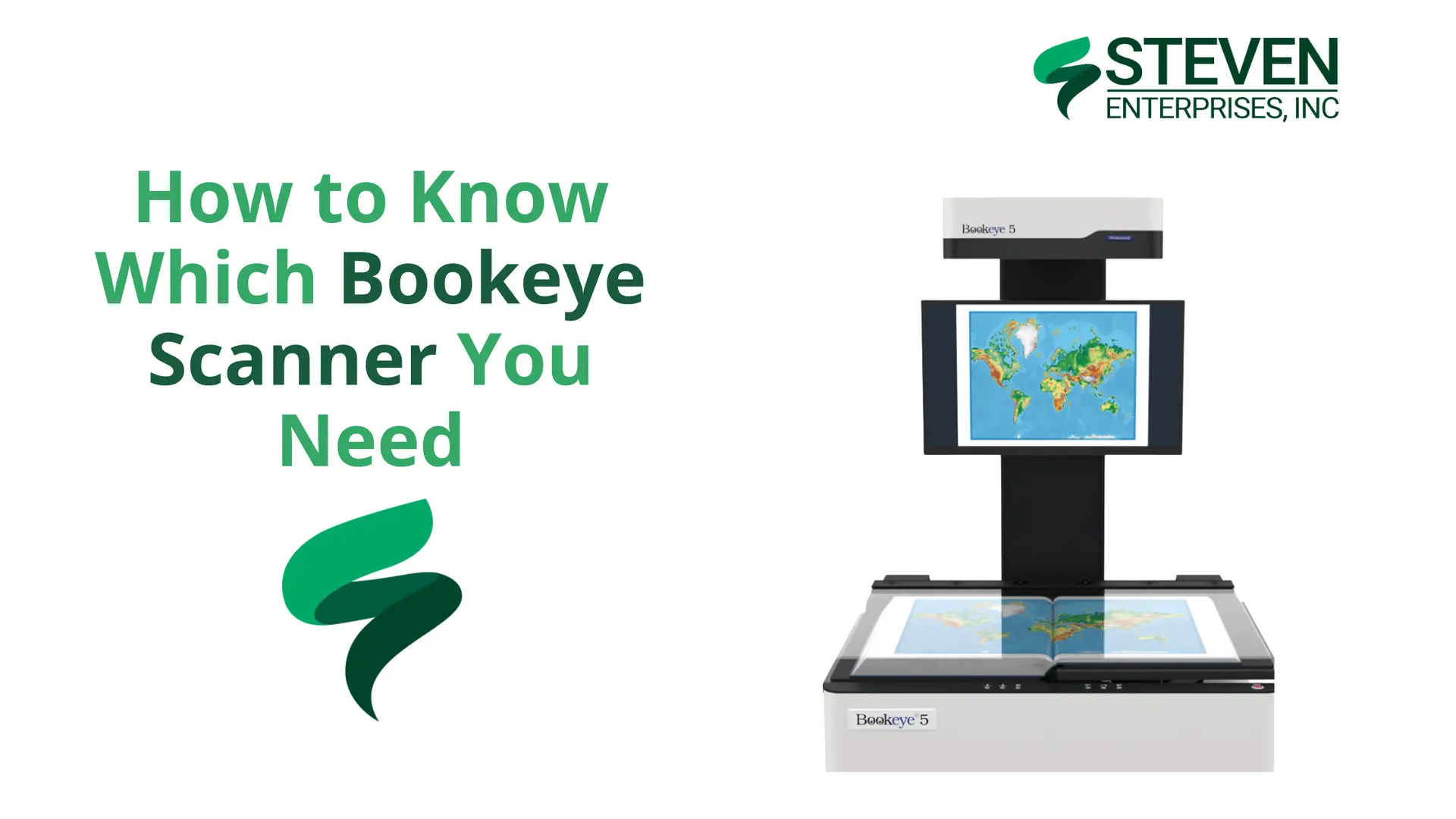
Bookeye scanners are professional-grade overhead book scanners designed specifically for digitizing bound materials without damaging them. The scanner has moveable cradles for the left and right sides of books.
The scanner can be left flat or raised for gentle handling of books or other types of bound or fragile material that flat scanners simply can’t handle safely.
Unlike flatbed scanners that require you to press books flat (potentially damaging the spine), Bookeye scanners use a V-shaped cradle system that supports books naturally.
This means you can digitize fragile historical documents, rare books, and bound materials without the stress of forcing them onto a flat surface.
Top Use Cases of Bookeye Scanners
The most common reason organizations invest in Bookeye scanners is simple: they need to make their old things digital. This includes:
- Scanning old books that are too fragile for traditional flatbed scanners
- Digitizing historical yearbooks to preserve memories and make them accessible
- Converting archives of bound documents, ledgers, and records
- Preserving rare manuscripts and historical texts
- Creating digital copies of frequently-used reference materials
Understanding the Bookeye Scanner Lineup
Choosing the right Bookeye scanner comes down to understanding your specific needs. Here’s how the main models break down:
Bookeye 5 V3: The Standard Choice for Most Applications

The Bookeye 5 V3 Overhead Book Scanner is a self-service book scanner for formats 50 % larger than A3 (390 x 480 mm/ 15.3 x 18.9 inch) makes it perfect for normal-sized books and most common digitization tasks.
Best for:
- Standard library books and textbooks
- Yearbooks and photo albums
- Regular archival documents
- High-volume scanning projects
- Self-service applications
The V3 is the most popular choice because it handles the majority of scanning scenarios while remaining cost-effective and user-friendly.
Bookeye 5 V2: Enhanced Features for Professional Use

The Bookeye 5 V2 has been fully redesigned to be even more eco-friendly, ergonomic and easy to operate than the previous Bookeye 4 models.
This model offers maximum efficiency throughout the entire scanning process with additional professional features.
Best for:
- Professional archives and museums
- High-quality digitization projects
- Organizations requiring maximum efficiency
- Projects needing enhanced image quality
- Institutions with demanding scanning requirements
Bookeye 5 V1A: The Specialist for Large Format Materials
The Bookeye 5 V1A Book Scanner Pro Edition is a high quality extra-large book scanner for professionals.
Scan large deed books, maps, and old ledgers with this scanner when standard scanners simply aren’t big enough.
Best for:
- Large historical ledgers and deed books
- Oversized maps and architectural drawings
- Extra-large yearbooks and photo albums
- Specialized archival collections
- Museums with unique large-format materials
Key Features That Matter for Your Decision
Scanning Platform Size
The most noticeable design change between the two models is the scanning platform size, which is larger on the Bookeye V2 than the Bookeye V3.
The V3 model features a 3 inch by 5-inch decrease in scanning platform size, making the unit more compact and affordable when compared to the V2 model.
Choose based on the largest materials you need to scan regularly.
Professional vs. Self-Service Use
Bookeye 5 V3 has all the advantages of a more expensive standalone device. Outfitted with an integrated color touchscreen and monitor, Bookeye 5 V3 can reach unrivaled scanning speeds and process large volumes of data independent of any external peripheral devices making it perfect for self-service environments.
Consider whether you need a scanner for trained operators or public use.
Image Quality Requirements
The Bookeye 5 V3 Professional Book Scanner is a FADGI compliant, CCD camera based book scanner for Libraries, museums and historical society’s high quality Archive needs ensures your digitization meets professional archival standards.
Which Bookeye Scanner is Right for You?
Choose Bookeye 5 V3 if you need:
- A scanner for normal-sized books and documents
- Self-service capability for public use
- Cost-effective solution for most digitization projects
- The most popular and versatile option
Go for the Bookeye 5 V2 if you need:
- Enhanced professional features and ergonomics
- Maximum efficiency for high-volume projects
- Superior image quality for archival purposes
- Advanced scanning capabilities
Choose Bookeye 5 V1A if you need:
- Extra-large format scanning capabilities
- Specialized scanning for oversized materials
- Professional-grade handling of unique collections
- Maximum flexibility for diverse material sizes
The Hidden Costs of Choosing the Wrong Scanner
Selecting the wrong Bookeye scanner can be expensive. Too small and you’ll struggle with larger materials or need multiple scanners. If it is too large, you might end up paying for capabilities you don’t need. Too basic and you might not achieve the image quality your projects require.
That’s why we always recommend a consultation to review your specific materials and requirements before making a decision.
Ready to Choose Your Ideal Bookeye Scanner?
Book scanners serve libraries, archives and digitization projects exceptionally well. They digitally preserve bound materials for future generations. Nonetheless, maximizing your investment depends on proper setup and training.
Our team provides comprehensive installation and training to ensure your staff can maximize the capabilities of your chosen Bookeye scanner from day one.
Don’t risk choosing the wrong scanner for your valuable materials.
Call 800-491-8785 or complete our contact form to speak with an expert who can help you select the ideal Bookeye scanner.