Posted on

Top Large Format Printer Brands for AEC Industry in 2025

For AEC professionals, the stakes are high. 

A scaling error in construction documents can cost thousands in field corrections. 

Poor color accuracy in architectural renderings can lose client presentations and slow printing speeds can delay project milestones. 

At Steven Enterprises, we have supported Southern California’s AEC community for over three generations to navigate the evolving landscape of large format printing technology. 

We’ve watched the industry shift from purely technical output to demanding hybrid capabilities; crisp CAD drawings in the morning and vibrant client presentations in the afternoon.

This guide explores the top large format printer brands we always recommend for AEC professionals..

Understanding Print Volume and Technology Choices

The fundamental decision between ink-based and toner-based technology remains critical, but here are the considerations that affect this choice:

  • Ink-Based Territory: Under 10,000 Square Feet Monthly
    Small to medium AEC firms like boutique architecture studios, specialized engineering consultancies, or regional construction companies, typically fall into this range. 

At approximately $0.025 per square foot, ink-based printing costs remain manageable while delivering superior color accuracy and fine detail reproduction.

  • Toner-Based Territory: 10,000-20,000+ Square Feet Monthly
    Larger operations like multi-discipline firms, major construction companies managing multiple projects, or regional headquarters producing plans for branch offices, benefit dramatically from toner’s $0.011 per square foot cost. 

At these volumes, the savings compound significantly: a firm printing 15,000 square feet monthly saves roughly $2,520 annually with toner versus ink.

The Real Cost Difference

While ink costs essentially double what toner costs per square foot, the decision involves more than simple math. 

Consider setup time, maintenance frequency, media versatility, and output quality for your specific applications. 

Sometimes paying more per print makes sense when it delivers capabilities your projects demand.

For comprehensive strategies on reducing printing supply expenses, explore our guide: How AEC Firms Can Maximize Savings on Large Format Printing Supplies.

Top Ink-Based Large Format Printer Brands for AEC

Ink-based printers continue dominating among AEC firms prioritizing output quality, color accuracy, and file complexity handling. 

HP Large Format Printers

HP maintains its leadership position in AEC technical printing through continuous innovation in AutoCAD file processing, dimensional accuracy, and integrated software solutions.

These printers handle the full spectrum of AEC printing needs: precise construction documents, color-coded MEP plans, and presentation-quality renderings. 

The HP Click mobile app, now standard across the DesignJet line, allows architects to print directly from project sites or client meetings without returning to the office.

Recent improvements in printhead technology have dramatically increased processing speed for complex CAD files. 

What once took 10-15 minutes to rip and print now completes in under 5 minutes; meaningful time savings when deadlines loom.

Recommended HP Series for AEC:

For detailed HP model comparisons organized by print volume and cost analysis, see: Top HP Wide Format Printers: Organized By Print Volume & Costs.

Canon Large Format Printers

Canon continues excelling in applications where color accuracy and visual impact determine success. 

While HP dominates purely technical printing, Canon leads when architectural visualization, photorealistic rendering, and presentation quality take priority.

Canon’s recent integration of acquired OCE technology brings improved technical printing capabilities to traditionally graphic-focused equipment. 

This convergence allows architecture firms to use one printer for both daily technical work and premium presentation output.

Understanding the distinction between graphic and technical printers helps clarify when Canon’s strengths matter most: Choosing Between Graphic and Technical Large Format Printers.

Top Toner-Based Large Format Printer Brands for AEC

Toner-based LED printers dominate in high-volume AEC environments where consistent speed and operating cost efficiency determine profitability. 

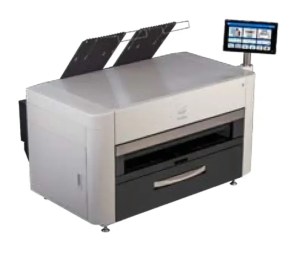
KIP Large Format Printers

KIP leads the toner-based market through relentless focus on software development and user experience. 

While other manufacturers emphasize hardware specifications, KIP invests in making printing easier, faster, and more intuitive. 

These qualities are particularly valuable in busy AEC environments where technical staff shouldn’t need to become printing experts.

Construction companies printing plan sets for multiple trades daily appreciate KIP’s consistent 10-12 page per minute output regardless of page coverage or complexity.

Recommended KIP Models for AEC:

  • KIP 700 Series: Mid-range with enhanced capabilities for growing practices
  • KIP 900 Series: High-capacity for major firms and construction companies

OCE Large Format Printers

OCE built its reputation on consistent, reliable performance in demanding production environments, exactly what AEC firms need when printing delays can impact project deadlines. 

Now fully integrated under Canon ownership, OCE equipment benefits from Canon’s technological innovation while maintaining the dependability that made OCE trusted in conservative AEC organizations.

OCE printers deliver steady, predictable performance without the learning curve or complexity some modern systems introduce. 

Engineering consultancies appreciate consistent line quality across extensive print runs. 

Construction companies value toner-based print durability in harsh jobsite conditions where ink-based prints might smudge or fade.

Recommended OCE Series for AEC:

Want to Upgrade Your AEC Printing Capabilities?

The Architecture, Engineering, and Construction (AEC) industry continues to evolve, and so do the printing technologies that support it. 

We understand that most firms develop brand loyalty for good reasons and we respect those preferences while ensuring you’re selecting equipment truly matched to your current and future needs.

Our team provides:

  • On-site workflow analysis identifying actual printing requirements
  • Side-by-side demonstrations of relevant equipment options
  • Installation, training, and ongoing support

Contact our team of experts or call (800) 491-8785 for personalized guidance tailored to your specific AEC discipline, print volume, and workflow requirements.

Posted on

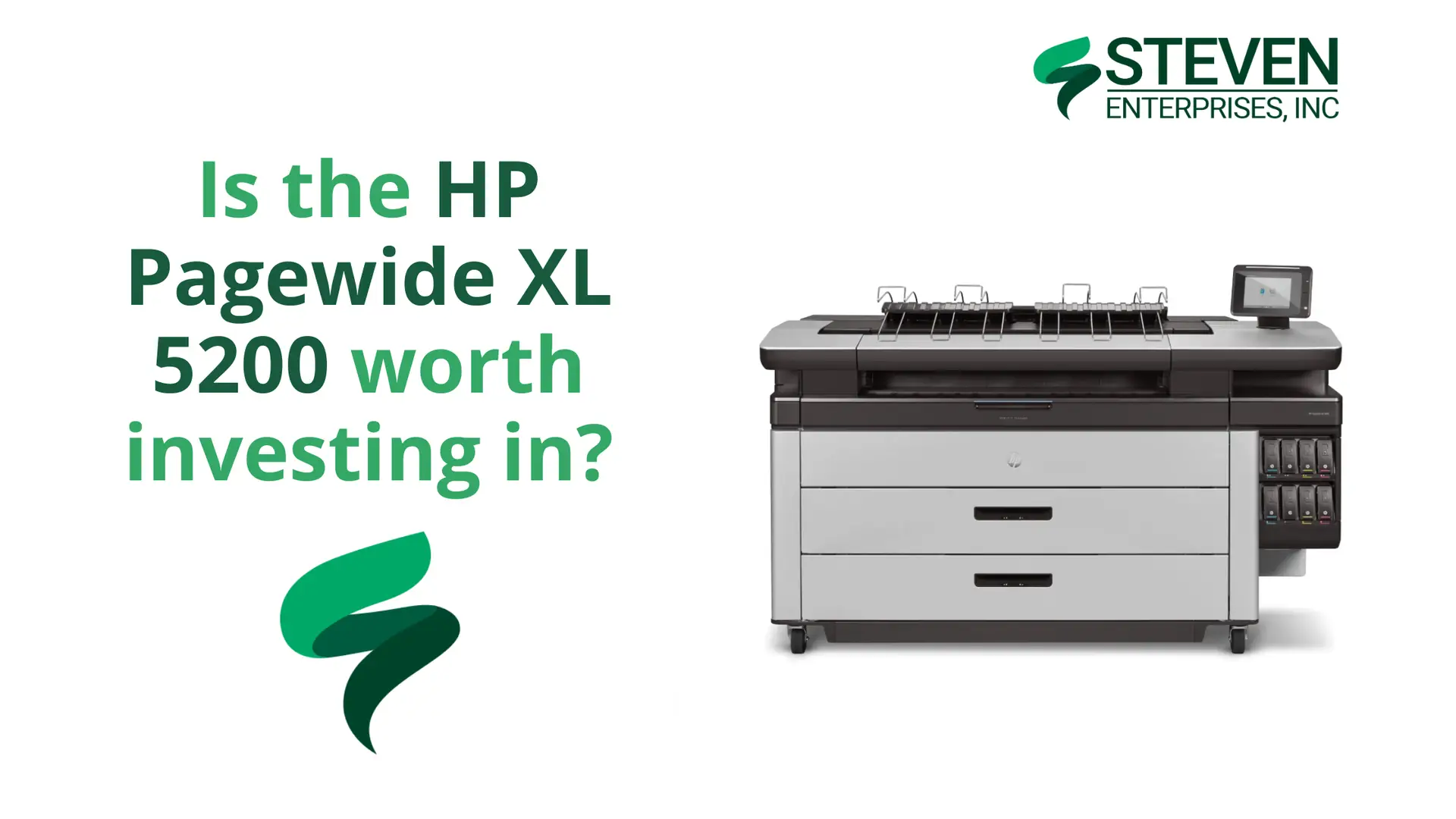
Is the HP Pagewide XL 5200 worth investing in?

Is the HP Pagewide XL 5200 worth investing in?

When it comes to high-volume printing in industries like architecture, engineering, and construction, choosing the right large format plotter can make or break project timelines. 

The HP PageWide XL 5200 is designed for businesses that need fast, reliable, and high-quality prints to keep complex projects moving forward.

At Steven Enterprises, we often get asked: “Is the HP PageWide XL 5200 worth investing in?” 

The answer depends on your printing needs, but for industries where detailed plans and quick turnarounds are critical, the XL 5200 is a powerhouse.

Let’s break down what makes this machine a smart investment for the right kind of workflow.

When the HP PageWide XL 5200 Makes Sense

High-Volume Operations: The 20,000+ Square Foot Threshold

HP PageWide XL 5200 Printer

The HP PageWide XL 5200 becomes cost-effective when your operation prints over 20,000 square feet per month. 

This speed is critical for industries that need quick turnarounds on large volumes of technical drawings, such as AutoCAD renderings, ensuring projects stay on schedule.

For example, printing multiple copies of building plans for handoffs among contractors is seamless and efficient.

Another good thing about this powerhouse is its reliability. 

It uses HP PageWide XL pigment inks for vivid colors, crisp lines, and fine details that outperform traditional LED printers, ensuring reliable output even under heavy workloads. 

This durability is ideal for demanding environments where equipment must perform consistently.

 The PageWide XL 5200 supports industries with complex dependencies, such as:

  • Engineering: Produces precise technical drawings for project planning.
  • Architects: Creates high-quality renderings for client presentations and contractor handoffs.
  • Construction: Supports rapid printing of updated plans to keep all teams aligned.
  • Electricians and Plumbers: Provides detailed schematics for accurate installations.
  • Fire Sprinkler Installations: Fire sprinkler installers, in particular, rely on highly detailed prints due to frequent changes driven by other contractors’ decisions. The PageWide XL 5200’s ability to produce precise, large-format prints ensures compliance and accuracy, even with frequent revisions.

Who Should Invest in the HP PageWide XL 5200?

HP PageWide XL Pro 5200 MFP

The 5200 excels in industries where multiple stakeholders depend on timely, accurate documentation:

Engineering Firms

Engineering companies managing complex projects require rapid turnaround on technical drawings, specifications, and design revisions. The 5200’s speed ensures engineering teams can meet tight deadlines while maintaining precision.

Architecture Practices

Large architectural firms working on multiple simultaneous projects need consistent, high-quality output for client presentations, permit submissions, and contractor communications.

Construction Management

General contractors coordinating multiple subcontractors require quick access to updated plans and specifications as projects evolve.

When the Investment Doesn’t Make Sense

Businesses printing less than 3,000 square feet per month typically can’t justify the 5200’s premium:

  • Underutilized capacity: The printer’s speed advantages aren’t realized at low volumes
  • Higher per-page costs: Premium equipment costs more to operate at low utilization
  • Simpler alternatives: Lower-volume operations can achieve adequate results with less expensive options

In these cases, a smaller model like the HP DesignJet XL 3800 may deliver the speed and reliability you want at a lower investment.

However, even some lower-volume teams choose the 5200 for its unmatched speed and reliability—especially if meeting deadlines is more valuable than saving on upfront cost.

See the Power of the HP PageWide XL 5200 in Action

The best way to understand the PageWide XL 5200’s capabilities is to see it yourself. At Steven Enterprises, we offer both:

  • In-person demos so you can test the machine directly
  • Virtual demos to see its performance from your office

Ready to explore whether the HP PageWide XL 5200 is worth it for your business? Fill this form today or call us at 800-491-8785 to schedule a demo and get the best pricing available.

Posted on

How IT Firms Can Boost Revenue by Reselling Wide Format Printers

Wide Format Printer

IT firms across the country are discovering a lucrative revenue stream that’s hiding in plain sight: reselling wide format printers to their Architecture, Engineering, and Construction (AEC) clients.

At Steven Enterprises, we have seen forward-thinking IT firms build steady income simply by guiding their AEC accounts through printer selection, network integration, and ongoing support.

Providing IT services to AEC businesses and haven’t explored this opportunity yet?

You’re missing out on significant additional income while your competitors are already capitalizing on this natural extension of IT services.

Here’s why wide-format printer sales are earning a place in the modern IT service stack and how to decide if this revenue channel belongs in yours.

Why IT Firms Are Perfect for Wide Format Printer Sales

As an IT professional, you are uniquely positioned to recommend and manage wide format printing solutions because you already understand your clients’ networks, security requirements, and operational needs. 

When AEC businesses need large format printing capabilities, they naturally turn to their trusted IT partners for guidance.

The relationship makes perfect sense. 

You are already managing their technology infrastructure, so adding printing solutions creates a seamless extension of your existing services while providing substantial additional revenue.

What Additional Income Streams Work Best for IT Firms?

Wide format printer reselling offers IT firms multiple revenue opportunities like:

  • Initial equipment sales with competitive margins
  • Network setup and integration services (your core expertise)
  • Ongoing maintenance and support contracts
  • Security monitoring and updates
  • User training and workflow optimization
  • Consumables and supplies management

This diversified income stream means you generate money from the initial sale and also build long-term, recurring revenue relationships.

The Strategic Advantage: Network Control and Security

Kip 600 Series Printer

When you help source and select wide format printers for your AEC clients, you gain several critical advantages:

  • Network Security Control: You choose machines you trust on your managed networks, eliminating potential security vulnerabilities from unknown or incompatible devices.
  • Brand Reliability: Leading manufacturers such as HP, KIP, and Canon all offer excellent software platforms with robust security features, providing confidence in the solutions you implement.
  • Ongoing Service Opportunities: Once printers are installed, you become the go-to resource for network integration, troubleshooting, security updates, and user support. This creates multiple touchpoints that strengthen your client relationships.

Which IT Service Models Work Best for Wide Format Printer Sales?

The opportunity varies based on your service model:

  • Large AEC companies typically have in-house IT departments that can become internal champions for your solutions
  • Smaller AEC firms usually rely on outsourced IT services, making you the natural point person for all technology decisions, including printing infrastructure.

Both scenarios present opportunities, but outsourced IT relationships often provide more direct influence over purchasing decisions.

Why are AEC Businesses Ideal Clients for This Service?

Colorado m3 Canon printer

Architecture, Engineering, and Construction firms have unique printing needs that require specialized knowledge:

  • Large format technical drawings and blueprints
  • High-volume document processing
  • Color accuracy for presentations and marketing materials
  • Network integration with existing CAD and project management systems
  • Security requirements for sensitive project data

Your existing relationship and technical expertise make you the ideal consultant for these specialized requirements.

How Does IT Involvement Improve Printing Security for Clients?

When you manage wide format printer selection and implementation, you provide significant security benefits to your AEC clients:

  • Risk Mitigation: You can evaluate and implement proper security protocols from day one, thereby preventing potential data breaches through the use of unsecured printing devices.
  • Network Integration: A professional setup ensures that printers are properly configured within existing security frameworks, rather than creating vulnerable access points.
  • Ongoing Monitoring: Your continued involvement means security updates and monitoring become part of your managed services offering.

What Cost Savings Can IT Firms Demonstrate to AEC Clients?

Beyond security benefits, you can show clients tangible cost savings:

  • Reduced downtime through proper network integration and ongoing support
  • Optimized printing workflows that improve productivity
  • Bulk purchasing power when you manage equipment procurement
  • Preventive maintenance that extends equipment life and reduces emergency service calls

How We Help IT Firms Succeed in Wide Format Sales

Expert Equipment Selection

Our team helps you select the machines that are best suited for your clients’ specific needs, taking into account their volume requirements, security standards, and integration needs.

Security Deep-Dive Analysis

We’ll provide you with detailed comparisons of security features across different brands (HP, KIP, Canon), giving you the technical knowledge to make informed recommendations and articulate security benefits to your clients.

Client Implementation Support

Steven Enterprises helps you pitch your clients by providing materials that clearly demonstrate the value proposition: cost savings for them combined with risk removal for potential security breaches.

We also handle all the technical legwork for your client relationship, making you more valuable as their trusted IT advisor while ensuring seamless implementation.

Are Other IT Firms Reselling Wide Format Printers?

IT firms across the country are already capitalizing on this opportunity. From coast to coast, smart IT professionals have recognized that wide format printer sales and management represent a natural evolution of their service offerings.

The trend is clear and in favor of IT service providers that deliver print services as part of a broader offering. 

Companies are asking their IT partners to “find a printer” because they trust their technical judgment and want integrated solutions.

What Happens If You Don’t Adapt?

If you’re not offering wide format printing solutions to your AEC clients, you’re likely missing revenue opportunities while competitors position themselves as more comprehensive technology partners.

The businesses that provide complete technology solutions—including printing infrastructure—become more valuable and harder to replace than those offering only traditional IT services.

Getting Started with Wide Format Printer Sales

Starting your wide format printer sales program doesn’t require massive upfront investment or extensive training. 

The key is maximizing your existing client relationships and technical expertise while partnering with experienced suppliers who can provide the specialized knowledge you need.

What Support Do You Need to Succeed?

Successful IT firms in this space rely on knowledgeable partners who can:

  • Provide technical specifications and comparisons
  • Offer competitive pricing and terms
  • Handle complex client questions about printing workflows
  • Support implementation and ongoing service needs
  • Keep you updated on new technologies and security features

Add Wide Format Printers to Your IT Service Portfolio

The opportunity to boost your revenue while providing additional value to your AEC clients is significant, but success requires the right partnership and approach.

Let us help you build this lucrative service offering while strengthening your client relationships.

Call 800-491-8785 or reach out through our contact form to discuss how we can help you capitalize on the wide format printing opportunity in your market.

We’ll help you do all the legwork for your clients, positioning you as their complete technology solution provider while building a profitable new revenue stream for your business.

Posted on

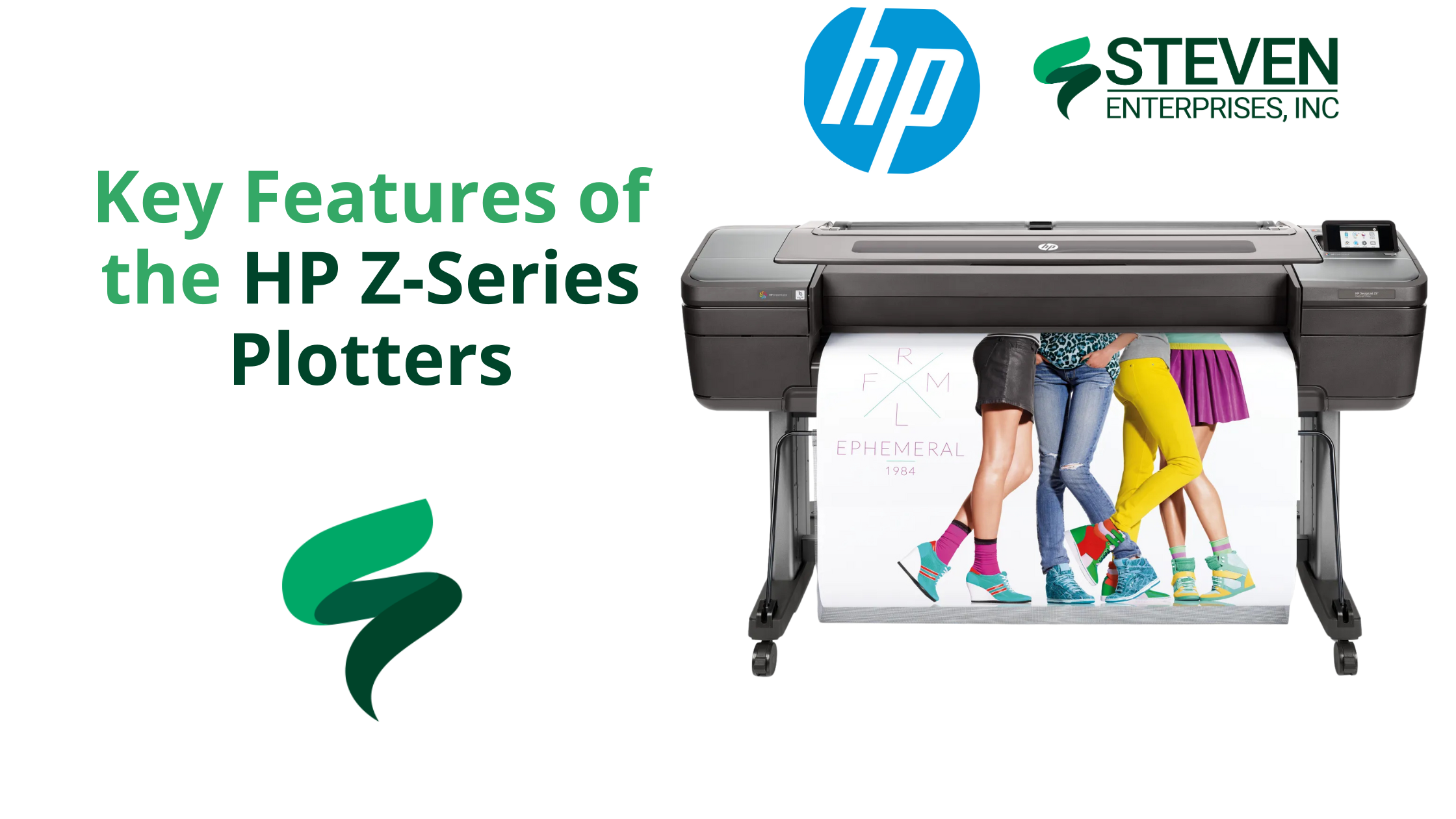
Key Features of the HP Z-Series Plotters

HP Z-9 Plotter

Marketing firms, schools, GIS departments, and retailers all face a common challenge: producing eye-catching, short-term signage on a tight schedule without overpaying for outsourced printing. 

Traditional print methods often increase costs, slow down turnarounds, and limit the types of media that can be used. 

Enter the HP Z-Series Plotters, a versatile line of large-format printers perfectly tailored to help you produce vibrant, durable, and budget-friendly graphics on demand.

At Steven Enterprises, we’ve seen organizations use the HP Z-Series to slash costs by as much as 40% while effectively doubling their output speeds.

Keep reading to learn why the Z-Series is the secret weapon for your short-term signage and graphic projects.

Who Needs HP Z-Series Plotters?

Below are three of the most common groups that benefit immediately from these devices.

1. Marketing Firms & Event Teams 

Outsourcing trade show graphics and large banners can lead to high costs, long wait times, and inconsistent quality.

How the HP Z-Series helps: In-house printing with a 44-inch or larger HP Z6 or HP Z9 means you can generate full-color banners, pop-up displays, or backdrop panels at the push of a button.

2. Schools & Universities

Most campuses need seasonal or event-specific signage, like orientation week “welcome” banners, open house yard signs, or commencement ceremony backdrops — but outsourcing can be slow and expensive.

How the HP Z-Series helps: With an HP Z-Series Plotter, schools can quickly create weather-resistant promotional materials. The pigment-based ink in the HP Z-Series can last up to six months outdoors under mild conditions, making it perfect for short-term campus way-finding signs, donor campaign banners, or A-frame stand inserts.

Universities often print vinyl or polypropylene A-frame signs to guide campus tours. Because polypropylene is tear-resistant and can handle high ink saturation, it’s ideal for directional signage that must withstand repeated handling or exposure to the elements.

3. Grocery Stores & Retailers

Retailers constantly update promotions — weekly specials, seasonal sales, and holiday deals. Sending each new design to a print shop is both costly and time-consuming.

How the HP Z-Series helps: With an HP Z-Series Plotter, retailers can produce vibrant window displays or point-of-sale posters in-house with fade-resistant pigment inks.

These inks can endure up to six months of UV exposure without significant fading, allowing you to create timely, large-scale retail graphics at a fraction of the usual outsourcing cost.

4. GIS Departments

Most municipal and governmental planning offices rely on precise, large-scale maps for city planning, infrastructure updates, or aerial imaging. Outsourcing each new revision can be slow and costly, mainly when last-minute changes occur.

How the HP Z-Series helps: With an HP Z6 Plotter, GIS professionals can print high-resolution, detail-oriented maps and schematics in-house, ensuring that line work, color-coded overlays, and small text remain crystal clear. 

Because the Z6 offers pigment-based inks and precise line rendering, everything from topographic contours to road networks looks sharp and true to scale.

Key Features and Benefits of the HP Z-Series

1. Versatile Media Handling

One of the standout advantages of HP Z-Series Plotters is their ability to handle a variety of printing materials, from basic bond paper to polypropylene and adhesive vinyl. 

This versatility allows you to create signage and graphics that can withstand more wear and tear than a standard paper poster. 

For instance, polypropylene is a semi-rigid thermoplastic that’s durable, resistant to tearing, and capable of handling high ink saturation for vivid colors. This is ideal for short-term displays that might be handled frequently or placed on foam board for easy transport.

2. Variable Size Options 

The HP Z-Series comes in 24-, 44-, and 64-inch models, ensuring there’s an option to match both your available floor space and your typical signage requirements:

  • 24″ Model: Ideal for tight office spaces or smaller projects.
  • 44″ Model: The most popular choice for general signage, trade show graphics, and point of sale materials—provides plenty of printing width without overwhelming your workspace.

Note: If you regularly switch between different paper types or sizes (e.g., adhesive vinyl and photo paper), you can save time by choosing a dual-roll configuration. This allows you to load two types of media simultaneously—no constant swapping. 

Select HP Z-Series models (specifically, the 44-inch HP Z6 or Z9) also offer a vertical trimmer, which is a built-in cutting tool that trims off both edges of your print for cleaner borders and more efficient finishing.

  • 64″ Model: This is ideal for niche markets that produce extra-large banners, such as specialized retail displays, entertainment venues, or any organization regularly needing signage over five feet wide.

3. Pigment-Based Ink for Outdoor Durability

HP’s pigment-based inks offer impressive color vibrancy and better outdoor resilience than typical dye-based inks. Your signage can last up to six months without significant fading under moderately controlled conditions (e.g., out of direct rain, but perhaps exposed to some humidity or sunlight).

That’s a huge benefit for short-term outdoor banners or in-store window displays that endure fluctuating interior or exterior conditions. Although these prints won’t hold up indefinitely in harsh weather, they can withstand the usual wear and tear of short promotional runs.

HP Z9 vs. HP Z6: Which Model is Right for You?

Choose the HP Z6 for Streamlined Signage and Graphics

  • Six-Color Setup: The Z6 features a six-color ink system optimized for sharp lines, solid areas of color, and excellent gradients. It’s perfect for short-term signage, banners, and general graphics.
  • Ideal for: Marketing teams, schools, retailers, and GIS departments who need sharp lines and vibrant color but don’t require ultra-precise color matching.

Pick the HP Z9 for Elevated Color Accuracy

HP Z SERIES

  • Nine-Color Setup and Optional Gloss Enhancer: The Z9 can achieve incredibly accurate colors, deeper blacks, and smoother gradations.
  • Ideal for:  Businesses or departments that demand color perfection (e.g., fine art studios, high-end brand agencies).

How to Make the Most of HP Z-Series Plotters

  1. Choose the Right Media. For high-traffic signage — like store displays or campus way-finding — durable materials (e.g., polypropylene or vinyl) help prints last. Consider high-quality photo paper for color-rich photography or premium trade show visuals.
  2. Stay on Top of Maintenance. Simple tasks like cleaning printheads and running occasional calibrations ensure you’ll consistently get top-notch prints.
  3. Consider Dual Roll & Vertical Trimmer. Switching between different paper sizes or materials? The dual-roll feature is a huge time saver. Coupled with the vertical cutter, you can produce nearly borderless prints at scale.
  4. Upgrade to the Z9 for Color-Critical Work. The Z9’s expanded ink set makes a noticeable difference for brand-accurate hues or detailed photographic prints. If color fidelity is your priority, that extra investment pays off in quality.

Transform Your Workflow with the HP Z-Series Plotter

Need short-term banners, point-of-sale posters, or GIS map prints that pop? There’s a Z-Series model with the speed, durability, and color accuracy you need.

Contact our team at 800-491-8785 or fill out our contact form for expert, personalized guidance. Let’s help you find the perfect match today.

Posted on

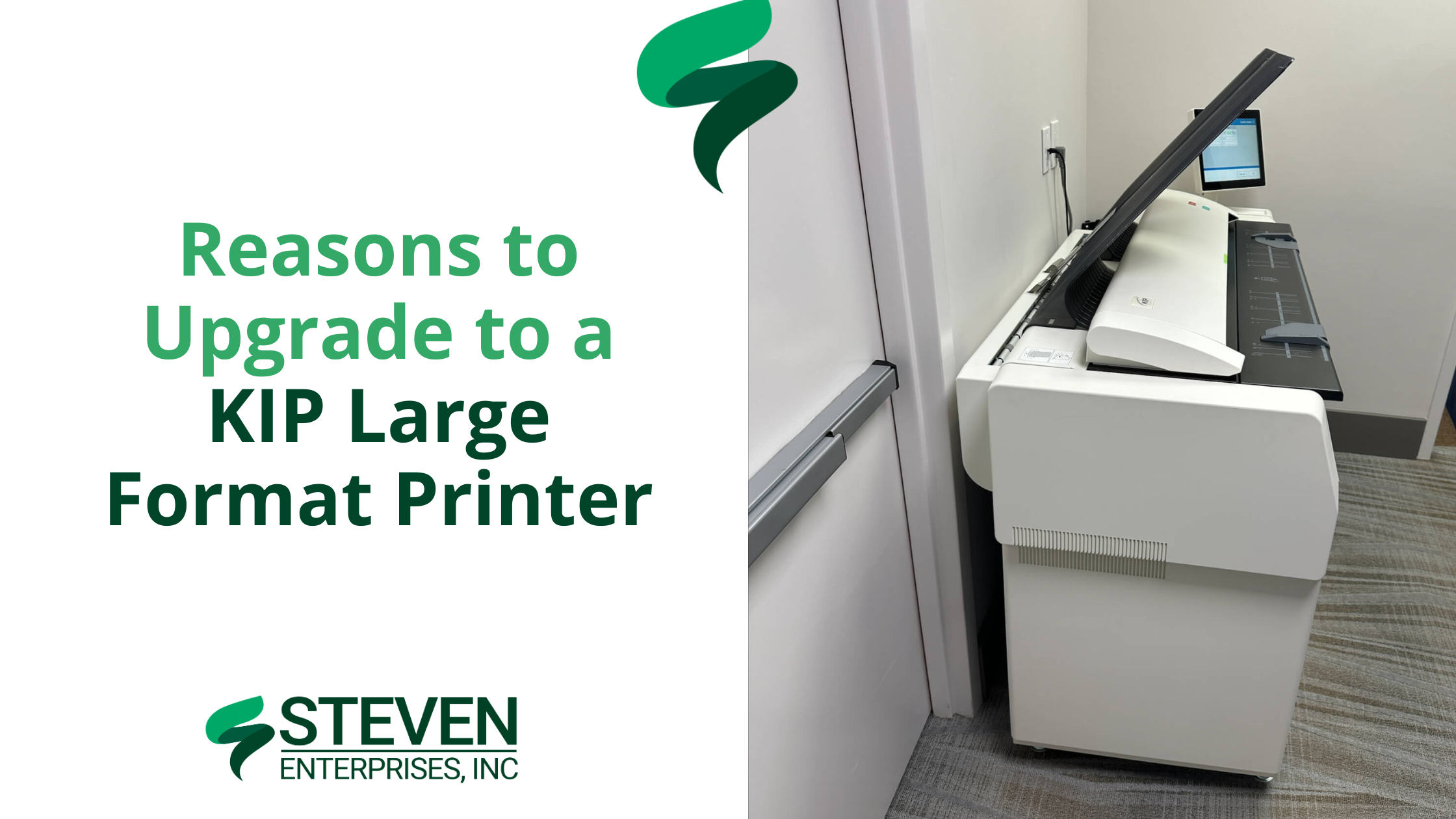
Reasons to Upgrade to a KIP Large Format Printer

For architects, engineers, and construction (AEC) firms, inconsistent print speeds and high ink costs can disrupt tight deadlines and strain budgets. 

A KIP Large Format Printer offers a solution with its toner-based technology, providing consistent print speeds, reduced operating costs, and features tailored to technical workflows.​

At Steven Enterprises, we’ve observed how KIP printers enhance AEC operations — reducing errors in bids by up to 35% and lowering color printing costs to approximately $0.20 per square foot. 

Our clients often produce over 500 D-size plans per hour, maintaining schedules and budgets.

In this article, we’ll highlight exactly why KIP printers are a great HP DesignJet alternative — and how your team can test one risk-free.

Who Needs a KIP Large Format Printer?

1. DesignJet & OCE Owners

KIP Large Format Printer

Many design and construction teams use inkjet models like the HP DesignJet XL 3600 or older OCE printers. However, these machines slow down significantly with high ink coverage — especially when printing detailed color renderings or redline markups. 

This bottleneck can push deadlines back by days or force teams to break large jobs into multiple smaller batches.

KIP’s toner-based systems maintain 6–20 pages per minute at any coverage. Whether you’re printing simple floor plans or heavily shaded 3D renderings, the speed never wavers. 

Plus, you can print both monochrome and color plans at the same rapid pace without switching devices or sacrificing color altogether.. 

2. Architecture, Engineering, and Construction (AEC) Firms

KIP Large Format Printer

In many architecture, engineering, and construction (AEC) environments, plans are printed in monochrome to save on costs. 

Unfortunately, crucial elements — like electrical, plumbing, and HVAC routes — can blend together without color differentiation, leading to confusion, errors in bids, and costly rework.

KIP printers excel at high-volume, color-accurate output at a fraction of the cost of traditional inkjets. 

By using different colors for each subsystem, redline markups and final plan sets become far clearer. This improves communication among trades, reduces misinterpretation, and helps contractors submit more accurate project bids.

If you’re looking to discover more about multi-roll devices and their benefits, visit our Large Format Printer Solutions page.

3. Organizations Seeking Greater Cost Reduction

KIP Large Format Printer image

Some companies primarily want to lower their ongoing print expenses — whether that’s due to rising ink costs or an uptick in color-coverage needs.

KIP’s toner approach offers a more predictable cost-per-print, especially on color-intensive jobs. 

Firms facing excessive ink usage or ballooning supply expenses often see immediate savings when switching to toner. 

This predictable pricing model helps budget-conscious teams accurately forecast their monthly print expenditures and avoid the frequent cartridge replacements common with inkjets.

KIP’s toner-based approach means more consistent expenditures. Instead of guessing how many ink cartridges you’ll burn through on color-heavy jobs, you pay roughly the same per page.

Why Choose a KIP Large Format Printer over Inkjets?

1. Toner Never Slows Down: Traditional inkjets might slow to a crawl when coverage goes beyond 50% — especially if you’re printing color-intensive renderings. 

KIP printers maintain 6–20 pages per minute no matter how much coverage you’re using. That means no more splitting large jobs into smaller batches.

2. Historically Expensive, Now More Cost-Effective: KIPs used to have a higher price tag compared to standard inkjets. But there has been a big industry shift: the cost of KIPs has come down, while their toner-based approach makes color prints far cheaper than ever before.

Many AEC firms significantly reduce color printing costs with KIP printers, achieving rates as low as $0.20 per square foot, compared to around $1.00 per square foot or more with many inkjets.

3. Perfect for High-Volume Printing: Every KIP model handles 2–4 rolls of media at once and offers built-in scanning. This setup is ideal for firms juggling multiple projects, letting you print technical drawings, color-coded markups, and even foam board or yard signs (with direct-to-board capabilities) from a single device.

How to Test a KIP Large Format Printer Risk-Free

To see how much you could save and how quickly you can print, call us at (800) 491-8785 or fill out our online form to request a personalized KIP demo.

We’ll print your actual plans or designs in real time, so you can see the color accuracy, speed, and cost savings firsthand.

You can ask questions as if you’re standing right in front of the machine. We’ll then mail you the completed prints for review.

It’s a simple, no-pressure way to find out how KIP can transform your printing process — especially if you’re comparing it to an HP DesignJet or older OCE model.

Posted on

Choosing the Best Large Format Printers for Redline Markups in AEC Projects

Choosing the Best Large Format Printers for Redline Markups in AEC Projects

If you’re affiliated with a large architecture firm or looking to upgrade your construction business’s redline markups printing capabilities, you’ve landed in the perfect spot. 

At Steven Enterprises, we specialize in equipping AEC companies with the best large format printers tailored for efficient redline markup processes. As such, our experts understand the nuances of architectural and engineering printing needs and are here to guide you.

How Printing is Involved with Redline Markups 

Redline markups play a critical role in architecture and construction projects, bridging the gap between initial designs and real-world execution. These annotations are made directly on large format CAD drawings, highlighting changes and adjustments necessary for project accuracy. After these adjustments, the marked-up drawings require high-quality scanning and printing for further reviews and revisions.

Key Features to Consider in Large Format Printers for AEC Firms

Engineering and Architectural Needs: The best large format printers for engineering and architectural firms combine high productivity with cost efficiency. Look for printers that deliver:

  • Speed and Efficiency: Fast printing capabilities are crucial. Opt for printers with high-yield consumables to reduce operational costs.
  • High-Quality Outputs: Precision is paramount. High-resolution printers ensure that every detail in schematics and blueprints is captured accurately.
  • Reliability and Service: Ensure minimal downtime with reliable printers supported by efficient customer service and maintenance options.

Construction Site Requirements: For construction sites, consider printers that offer:

  • Portability: Compact printers are ideal for the limited space in job site trailers.
  • Scanning Capabilities: Multi-functional printers that include scanning can expedite communication and project approvals.
  • Ink Durability: Opt for pigment-based inks for their durability in harsh conditions, preventing smudges and damage.

Popular Large Format Printers for redline markups by Printing Volume

AEC firms typically choose from a few popular large format printers from brands like HP, Canon, and KIP. The main deciding factor in which machine to use is your monthly printing volume as a firm. 

The more you print, the more ink & paper supplies you’ll need to buy every month.

So, as you scale, the type of printer you’ll need will also change.

Small AEC Firms 

Printing Volume: Under 5K square feet per month

 Models like the HP DesignJet T-2600 and the HP DesignJet XT950 are perfect for firms with monthly outputs under 5,000 square feet. Some DesignJets use pigment ink, which is a popular choice for it’s durable water-resistant prints. 

Midmarket AEC Firms

Printing Volume: Between 5K-10K square feet per month 

For firms printing up to 10,000 square feet monthly, the KIP 71 series and the HP DesignJet XL 3600/3800 MFP are popular choices because of their multi-functional feature to both print and scan. 

Large AEC Firms 

Printing Volume: Above 10K square feet per month 

Finally, to be able to handle high volumes like these, you’ll likely look at buying the HP Pagewide series. These powerful printers can do up to 30 pages per minute, which is much faster than the 6 pages per minute of the midmarket printers. 

Get a Free Plotter Consultation with a Printing Expert

Understanding your firm’s specific needs is crucial when selecting a large format printer. Therefore, Steven Enterprises experts are here to help find you a printer that fits your current needs and contributes to long-term savings and efficiency.

Ready to maximize your AEC firm’s printing efficiency? Contact us today for a personalized consultation by either filling out this form or speaking to an expert immediately by calling 800-491-8785.

Posted on 1 Comment

How AEC Firms Can Maximize Savings on Large Format Printing Supplies

HP Pagewide Pro 10000, a recommended printer upgrade for cost-effective large format printing

For Architecture and Engineering (AEC) firms, the cost of large format printing supplies can be a significant expense. Ranging anywhere from a couple hundred dollars per month to well into the tens of thousands. 

 However, a little-known fact could change the game: the model of your large format printer directly influences your printer supply costs. 

Lower-model printers often have higher ink costs, whereas higher-model printers can dramatically reduce these expenses.

For most Architecture Engineering (AEC) firms, this calculation is carefully done by a specialized printing expert during their purchase. But as the firm grows and expands, savings could be missed. 

In this blog post, we’ll review examples of how AEC firms can save big on their large format printing supplies if they were to consult a Plotter Expert about trading in their old printer for a higher model. 

The Impact of Large Format Printer Models on Printer Supplies Costs

The large format printers are designed with efficiency in mind: the more advanced the model, the more cost-effective the printing. 

This means that investing in a higher-model printer can lead to substantial savings on ink and other supplies in the long run.

Understanding the Cost Differences

Let’s break down the potential savings through two scenarios within an average-sized AEC firm, highlighting the difference in large format printing supplies costs between lower and higher-level printer models.

Scenario 1: Lower Model Printer = Higher Large Format Printing Supplies Costs

Let’s say your firm decided to buy the HP Z-series printer, which was the more affordable printer at the time. Every month you print roughly 50K prints overall, which is pretty standard for a medium-sized AEC firm.

Since each type of print has a different ink cost, let’s say your AEC firm did the following volume of prints: 

  • 40% low-density prints (20K prints) 
  • 30% mono line prints (15K prints) 
  • 25% color lines (12.5K prints) 
  • 5% high-density prints (2,500 prints) 

= 50K prints per month 

Let’s calculate a rough monthly investment in your large format printing supplies: 

  • 20K low-density prints x $0.2/print = $4000
  • 15K mono line prints x $0.03/print = $450
  • 12.5K color lines x $0.03/print = $375
  • 2.5K high-density prints x $0.46/print = $1,150 

= $5,975 per month in printing supplies

Scenario 2: Higher Model Printer = Lower Large Format Printing Supplies Costs

Now, let’s say you purchased the Pagewide Pro 10,000 to be more aligned with your printing needs (after speaking to a printing specialist, of course). 

In this scenario, your cost for ink will drop significantly because you went with the higher-level printer. Assuming your printing volume stays the same, here’s the new calculation: 

  • 20K low-density prints x $0.019/print = $380
  • 15K mono line prints x $0.0038/print = $57
  • 12.5K color lines x $0.0038/print = $47.5
  • 2.5K high-density prints x $0.054/print = $135

= $619.50 per month in printing supplies

Switching over to the higher model printer could end up saving this business almost $65,000 per year in print supply costs. This means that in a matter of months, this upgrade will be more than paid for!  

Calculating Your Possible Savings on Large Format Printing Supplies 

Many different AEC firms stand to save a ton of money in their monthly expenses if they were to run this calculation for their firm. 

In the examples above, we’re comparing a top-of-the-line model to a lower-level model for a relatively high printing volume to demonstrate the possibilities. 

Broadly speaking, AEC firms spending around $5,000 monthly on printer supplies (or printing about 10K square feet per month) could see significant savings by upgrading their printers. 

Want to see how much you can save? Make a copy of our Ink Costs Calculator to input your printing volume and see your monthly & annual savings. 

The Added Benefits of Upgrading Your Printer

Upgrading your printer is not just about saving on supplies. Newer models often require less maintenance, use ink more efficiently, and can enhance your team’s productivity by reducing downtime.

Print shops, architecture firms, and engineering firms who bought their printers over 3 years ago now likely have way better printer models they could be using.  

Ask yourself: What could this increase in productivity and efficiency mean for your firm? 

Printer Upgrades We Commonly Recommend

At Steven Enterprises, we understand the true cost of ownership extends beyond the initial purchase. This is why we provide unprecedented value in our comprehensive plotter maintenance & supplies offers post-purchase.

The HP Pagewide series, for instance, offers larger ink cartridges the higher model you buy, resulting in fewer replacements and more savings. For example, the newer inks are coming in 1-5 liter ink cartridges vs. 775ml in the older models. This means the ink cartridge is 5x larger than before, adding up to significant savings if your firm is printing the right volume. 

Get a Free Plotter Consultation with a Printing Expert

Understanding the specific needs and printing volume of your firm is crucial in choosing the right printer model. 

Our printer equipment specialists are here to guide you through this process, ensuring you invest in a printer that not only meets your current needs but also provides significant long-term savings.

Ready to explore how much you could save with a printer upgrade? 

Contact us for a personalized consultation and discover the most cost-effective solutions for your AEC firm.

Either fill out this form or speak to an expert right away by calling 800-491-8785.

Posted on 1 Comment

Best Large Format Printers for Engineering Firms to Maximize Operating Efficiency in 2025

An engineer reviewing a large format print of a blueprint produced by a top 2024 XL HP printer in an engineering firm.

Engineering plans often evolve, don’t they? The ability to print the latest versions right within your office walls can greatly streamline collaboration, minimize misunderstandings, and lead to significant time savings for your engineering firm. 

Printers for engineering firms, commonly referred to as large format printers, are typically all equipped to handle tasks such as printing blueprints, schematics, and much more. 

But beyond just the basic needs, there are some newer large format printers on the market this year that bring several unique benefits to engineering firms, enhancing their overall operational efficiency.

In this blog post, we’ll review the top brands that Steven Enterprises Equipment and Account Specialists recommend to our engineering customers and explain the basic differences in the latest models on the market. 

What Engineers Must Look for in Their Large Format Printers

The ideal large format printer for an engineering firm isn’t just about size; it’s about marrying high productivity with cost efficiency. Your printers should deliver exceptional quality and ensure reliability.

  • High-Yield Consumables for High-Productivity Printing: Efficiency is paramount in engineering. Printers that offer high-yield consumables can significantly lower operational costs, enabling engineers to focus on productivity without worrying about resources.
  • Deliver the High-Quality Printing Your Business Demands: In the detail-oriented field of engineering, the quality of printed materials can’t be compromised. High-resolution prints are essential for accurately conveying complex schematics and blueprints.
  • Be Reliable and Easily Serviced: Downtime isn’t an option in high-stakes engineering projects. A printer sourced from reputable suppliers like Steven Enterprises not only promises quality but also guarantees swift service and proactive maintenance, ensuring your printer is always up and running.

Top Large Format Printers Brands for Engineering Firms

HP PageWide XL Series

A revolution in wide-format printing, the HP PageWide XL series is designed for speed, efficiency, and quality. 

From the HP PageWide XL 10000’s astounding 700m²/hour output to the XL 4200’s precision and economy, this series is tailored for varying scales of engineering demands. 

The PageWide XL series meets every engineering firm’s needs. For example, one capability is that it can print on diverse media thanks to a no-heat pigment ink process. In addition to that, the printer also has the distinction of being the most secure printer available today. 

Check out the latest HP PageWide XL series here.

KIP 900 Series

For engineering firms with a high demand for consistent productivity and bold colors, the KIP 900 series stands out. 

Offering unparalleled color fidelity and durability, these printers are ideal for a wide array of printing tasks. From technical documents to vibrant posters, this printer has it all.

The KIP 900’s toner-based system combines affordability, speed, and waterproof quality, making it a robust choice for engineering applications.

Check out the latest KIP 900 Series here.

Oce (Canon) PlotWave Series

The Oce PlotWave series by Canon Solutions America is celebrated for its user-friendly interface and intelligent automation. 

Designed to deliver reliable, high-quality prints with strong security features, the PlotWave series is a prime choice for engineering firms prioritizing productivity and ease of use. 

With models like the PlotWave 7500 offering rapid printing and up to six rolls of media, it’s built for the demands of the engineering sector.

Check out the latest Plotwave OCE printers here.

Best Overall: HP DesignJet XL 3800 Multi-Function Printer

The evolution of color printing over the last five years has been nothing short of revolutionary, especially with the advent of the HP DesignJet XL 3800 Large Format Printer.

This breakthrough technology has significantly lowered the financial barrier to high-quality color printing for engineering firms. In turn, marking a departure from the era when such capabilities commanded a price tag upwards of $100,000.

With features like enhanced printing speeds, batch scanning, and a compact design, it addresses all the needs of engineering firms. Especially for those looking for reliability, efficiency, and a smaller environmental footprint.

This is why we determined the HP DesignJet XL 3800 to be the overall winner for the best large format printer for engineering firms. 

Read more: New HP XL DesignJet 3800 Multi-Function Printer: A Comparison to Black & White Models

Need Help Choosing the Right Large Format Printer for Your Engineering Firm?

In a rapidly evolving engineering industry, staying ahead with the best tools is not just an option—it’s a necessity. 

Upgrade to the leading large format printers of 2025 and watch your engineering firm reach new heights of efficiency and quality.

Let Steven Enterprises be your go-to source to identify the right large format printers for your engineering firm. Speak to one of our Equipment and Account Specialists to tap into their in-depth industry experience in the printing industry for free. 

Contact us today by filling out this form or give us a call right away at 800-491-8785.