Posted on

Choosing the Best Large Format Printers for Redline Markups in AEC Projects

Choosing the Best Large Format Printers for Redline Markups in AEC Projects

If you’re affiliated with a large architecture firm or looking to upgrade your construction business’s redline markups printing capabilities, you’ve landed in the perfect spot. 

At Steven Enterprises, we specialize in equipping AEC companies with the best large format printers tailored for efficient redline markup processes. As such, our experts understand the nuances of architectural and engineering printing needs and are here to guide you.

How Printing is Involved with Redline Markups 

Redline markups play a critical role in architecture and construction projects, bridging the gap between initial designs and real-world execution. These annotations are made directly on large format CAD drawings, highlighting changes and adjustments necessary for project accuracy. After these adjustments, the marked-up drawings require high-quality scanning and printing for further reviews and revisions.

Key Features to Consider in Large Format Printers for AEC Firms

Engineering and Architectural Needs: The best large format printers for engineering and architectural firms combine high productivity with cost efficiency. Look for printers that deliver:

  • Speed and Efficiency: Fast printing capabilities are crucial. Opt for printers with high-yield consumables to reduce operational costs.
  • High-Quality Outputs: Precision is paramount. High-resolution printers ensure that every detail in schematics and blueprints is captured accurately.
  • Reliability and Service: Ensure minimal downtime with reliable printers supported by efficient customer service and maintenance options.

Construction Site Requirements: For construction sites, consider printers that offer:

  • Portability: Compact printers are ideal for the limited space in job site trailers.
  • Scanning Capabilities: Multi-functional printers that include scanning can expedite communication and project approvals.
  • Ink Durability: Opt for pigment-based inks for their durability in harsh conditions, preventing smudges and damage.

Popular Large Format Printers for redline markups by Printing Volume

AEC firms typically choose from a few popular large format printers from brands like HP, Canon, and KIP. The main deciding factor in which machine to use is your monthly printing volume as a firm. 

The more you print, the more ink & paper supplies you’ll need to buy every month.

So, as you scale, the type of printer you’ll need will also change.

Small AEC Firms 

Printing Volume: Under 5K square feet per month

 Models like the HP DesignJet T-2600 and the HP DesignJet XT950 are perfect for firms with monthly outputs under 5,000 square feet. Some DesignJets use pigment ink, which is a popular choice for it’s durable water-resistant prints. 

Midmarket AEC Firms

Printing Volume: Between 5K-10K square feet per month 

For firms printing up to 10,000 square feet monthly, the KIP 71 series and the HP DesignJet XL 3600/3800 MFP are popular choices because of their multi-functional feature to both print and scan. 

Large AEC Firms 

Printing Volume: Above 10K square feet per month 

Finally, to be able to handle high volumes like these, you’ll likely look at buying the HP Pagewide series. These powerful printers can do up to 30 pages per minute, which is much faster than the 6 pages per minute of the midmarket printers. 

Get a Free Plotter Consultation with a Printing Expert

Understanding your firm’s specific needs is crucial when selecting a large format printer. Therefore, Steven Enterprises experts are here to help find you a printer that fits your current needs and contributes to long-term savings and efficiency.

Ready to maximize your AEC firm’s printing efficiency? Contact us today for a personalized consultation by either filling out this form or speaking to an expert immediately by calling 800-491-8785.
Posted on

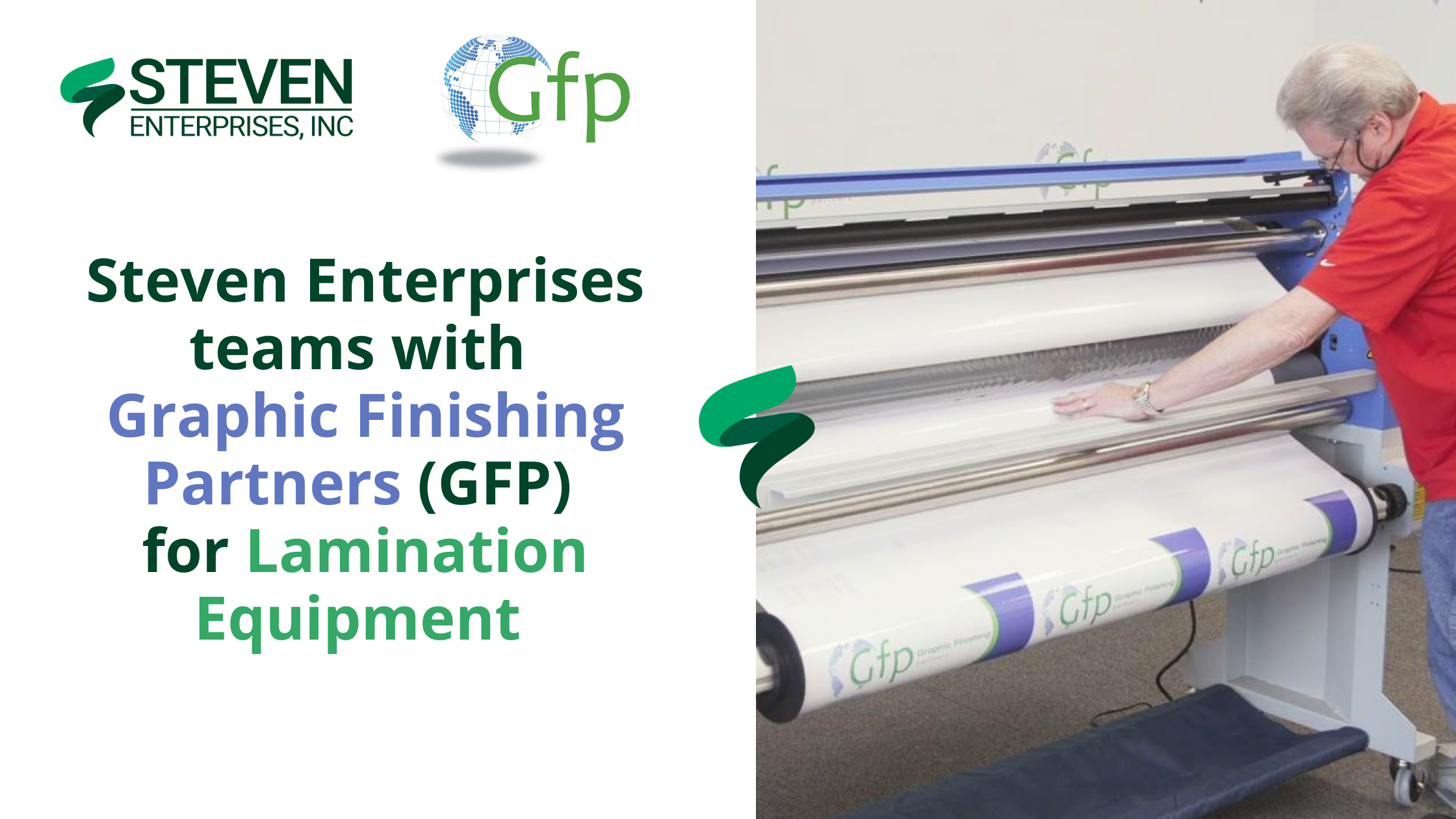
Steven Enterprises teams with Graphic Finishing Partners (GFP) for Lamination Equipment

Gfp laminator machines are the perfect complement to the latest wide format inkjet printers. Find out more about the proven to shorten production time, increase profitability, & professional results.

Nothing grows the success of a print service provider like quality on-time results. That’s why Steven Enterprises is proud to announce a new partnership with a leader in lamination equipment and supplies, Graphic Finishing Partners LLC. 

Gfp laminator machines are the perfect complement to the latest wide format inkjet printers. They are proven to shorten production time, increase profitability, and produce consistent, professional results.  

Find out more about our new partnership and which laminators our printing experts recommend most to our customers. 

Who is Gfp Laminators? 

Graphic Finishing Partners LLC (Gfp) opened its doors in 2009 in response to the

growing need for more affordable yet efficient, high quality print finishing equipment and supplies. 

Gfp laminators are known in the printing industry for their simplicity to operate, full of labor-saving features, and easy on the budget.

Their mission is to provide finishing shops with the tools they need to produce profitable results while helping them keep their costs down. 

For more information about Graphic Finishing Partners LLC, visit gfpartnersllc.com.

Why Choose Gfp Laminators?

Rugged and reliable, Gfp finishing equipment offers several ways to achieve application flexibility. 

Whether you produce & sell laminated signs, mount photos and graphics as a service, or simply want to laminate point-of-purchase and trade show displays, banners, or window, floor and vehicle graphics – Gfp laminators can do it all!  

Another key benefit of purchasing your laminator from Gfp is that it comes with a One Year Parts & Labor Warranty

Not to mention that installation, operator training and service support are readily available through Steven Enterprises service technicians

Why Purchase Lamination Equipment for Your Printing Hub?

Despite the significant development and innovation in office technology, laminators are still considered essential tools for preserving important documents in schools, offices, homes, and print shops.

Lamination is a popular way to protect and improve the quality and durability of printed materials, especially if they’re leafed through frequently.

Businesses who handle important printed materials daily without laminating them typically will have to re-print far more often because of damage. Fingerprints, rips, folds, spillages and stains are all common issues with documents that aren’t properly laminated. 

Not to mention, with a laminator your documents will look far more professional.

It’s often used for restaurant menus, price/part lists, business cards, educational and training materials, maps, and bookmarks. That said, Steven Enterprises also commonly sells Gfp laminators to government entities for roadway signs and other large format posters that need to be produced at scale. 

If your business frequently prints materials that will be outside, laminating will typically extend the durability 5+ years! 

Cold vs Hot Laminators – Which one to choose?

Choosing the right kind of laminator can be a daunting task, especially for first-time buyers. A common problem when selecting a laminator is the uncertainty surrounding whether to opt for a hot or cold laminator. 

The primary difference between hot vs. cold lamination depends on how the plastic is applied to the document by the laminating machine:

  • Hot laminators are exceptional machines for laminating pressure-sensitive materials with a crystal-clear finish. These laminators use heat to activate and melt the adhesive of the lamination film to bond with the material. 
  • Cold laminators are innovative machines that protect heat-sensitive materials prone to heat damage. They use pressure to bond two layers of material together to create a crease-free protective coating. 

At Steven Enterprises, we typically sell the hot laminators more often. However, we understand that every business is unique. 

If you’re unsure which laminator you should buy, talk with one of our printing experts.

Top Lamination Equipment By GFP We Recommend

GFP Laminators 300 Series: Professional 55″ and 63″GFP Laminators 300 Series: Professional 55" and 63"

Smaller shops who don’t need to laminate all too often typically choose the 300 series, as it is a affordable option for pressure-sensitive applications. 

The Gfp 300 series delivers rugged construction, labor-savings features, and high quality output in an entry level machine. 

Built off the 255C Cold Laminator, the 300 series adds top heat for better overlamination, mounting and board coating results.

Learn more about the Gfp 300 Series laminators here.

GFP Laminators 500 Series: Production 63″ GFP Laminators 500 Series: Production 63" 

For businesses that have a slightly higher volume of laminated projects, the 500 series is definitely the way to go. It has a 50% faster throughput and quick application changes save time, effort and money.

Some key features for these powerful production-quality laminators include: 

    • Swing-out quick-grip supply shafts: Helping you replace rolls easily during large lamination projects 
    • Drop-in quick-grip rewind shafts: Includes motorized rear rewind with rotary slitters for roll-to-roll applications
    • Photoelectric eye: For enhanced safety for your laminator operators   
    • Media Alignment disks: To keep your supply rolls from telescoping
    • Swing-up feed table: With a tall 38″ output height for easy finishing on most surfaces
    • Metal Alloy heater: To help reduces breakage during mass production
    • Roller gap measurement scale: Standard 4.4″ diameter rollers, to keep supply costs low

Learn more about the Gfp 500 Series laminators here.

GFP Laminators 600 Series: Top Heat LaminatorsGFP Laminators 600 Series: Top Heat Laminators

If your business has a higher print volume that needs to be laminated at high speeds, the 600-series is potentially worth the upgrade. 

Everything from the 500 series, plus these key features: 

    • Smart Finishing Technology
    • Digital microprocessor

Learn more about the Gfp 600 Series Top Heat Laminators here.

Need Help Purchasing the Right Lamination Equipment for your business?

If you’re hoping to purchase or upgrade to a Gfp Laminator, we’d be happy to provide you a free consultation with one of our laminator specialists. 

Call us now at 800-491-8785 or send us an inquiry.

Posted on

Top Canon OCE PlotWave Printers for 2025: Organized By Print Speed & Price

When the OCE PlotWave launched in 2009, these large format printers offered reliable, easy production of high-quality prints. Many AEC firms chose the OCE brand because of their built-to-last design philosophy.

Unsurprisingly, in November 2009, Canon and Océ announced a conditional agreement wherein Canon would buy all the shares of Océ in a fully Canon-funded, public cash offer. 

Based on more than a decade of market-leading success, the 6th generation of the popular OCE PlotWave printers has come to the market. 

In this article, we’ll explain what makes the Canon OCE PlotWave printers so popular and review the top printers Steven Enterprises’ printing experts recommend to our customers in 2025.

Industries Who Commonly Purchase the PlotWave Large Format Printers

The plotWAVE T-series printers are developed for producers of technical drawings and designs who want an integrated, easy-to-operate solution. 

These large-format printers have been developed for users in architecture, engineering, construction (AEC), and manufacturing companies. 

In addition to those main industries, the technology is also efficient for government offices, education, and professional print shops handling larger sets of technical documents.

Unique Features of the Canon OCE PlotWave Printer

Compared to the other technical large-format printers on the market, the Canon OCE PlotWave is definitely one of the more versatile ones. Walk-up users will appreciate the possibility of combining all their printing, scanning, and copying tasks on a single device with a wide variety of media available.

That said, a few key features distinguish this new generation of the OCE PlotWave from the competition.

1. Patented Radiant Fusing Technology 

Radiant Fusing technology is an eco-friendly fusing method that provides instant printer availability with no warm-up time. It consumes less energy and emits less noise and ozone than conventional fusing methods. 

This printer is Energy Star® 3.0 certified and uses toner bottles with an average of 50% recycled materials. So, if your business has sustainable initiatives and wants to be environmentally friendly, this large-format printer can support that. 

2. Updated IT Security Software & Features

In addition to the environmental benefits, business owners who purchase the Canon OCE PlotWave appreciate the convenient, fast, and reliable multitasking with the secure POWERsync controller (running on Microsoft Windows® 10 iOT LTSC21). 

The printer has the entire PRISMA and Clear Connect software suite, making it easy to manage complex jobs and avoid misprints. Despite the multiple driver software applications, most printer operations still review the Canon OCE Plotwave to have an intuitive user interface. 

3. Practical Add-ons for Large Teams

The 6th generation of the OCE PlotWave now includes an automatic remaining media indicator and an optional user attention light, making the printer easy to use for large teams.

The user attention light sits on the back of the printer and indicates when the printer is ready to be used. A green light indicates it’s ready to be used, whereas a flashing red light means something is wrong. While seemingly insignificant, this light is helpful for large firms where only a small portion of those operating the printer will be trained to maintain it.

Top 3 Canon OCE PlotWave Printers By Print Volume 

Now that you know more about the OCE PlotWave printers, let’s examine the top three large-format printers that Steven Enterprises’ printing experts recommend to our customers most. 

Canon OCE plotWAVE T-35

  • Target Users: If your business prints less than 5K sq feet per month, the most affordable & best quality OCE plotWave is going to be the T-35. 
  • Speed: Delivers up to 4 D/min                                                                    
  • Size: Can fit up to 2 rolls
  • Main differentiator: Reliable performance and lasting quality

Learn more about the plotWAVE T-35 model.

Canon OCE plotWAVE T-55

  • Target Users: If your business prints more than 5K sq feet per month, we recommend the T-55 model.  
  • Speed: Delivers up to 8 D/min (double the speed of the T-35)
  • Size: Can fit up to 4 rolls  (double the speed of the T-35)
  • Main differentiator: T-series printers are built for reliability and uptime,
  • with minimal burden of daily maintenance.

Learn more about the plotWAVE T-55 model.

Canon OCE plotWAVE T-75

  • Target Users: If your business prints more than 15K sq feet per month, you’ll need to invest in the most powerful OCE in the T-series: T-75
  • Speed: Delivers up to 10 D/min 
  • Size: Can fit up to 6 rolls 
  • Main differentiator: Easily manage high-demand technical printing

Learn more about the plotWAVE T-75 model.

Need Help Choosing Between the Top Canon OCE Large Format Printers?

In a rapidly evolving large format printing industry, staying ahead with the best tools is not just an option—it’s a necessity. 

Let Steven Enterprises be your go-to source for identifying the right large-format printers for your business. Speak to one of our Equipment and Account Specialists for free to tap into their in-depth industry experience. 

Contact us today by filling out this form or call us at 800-491-8785.

Posted on

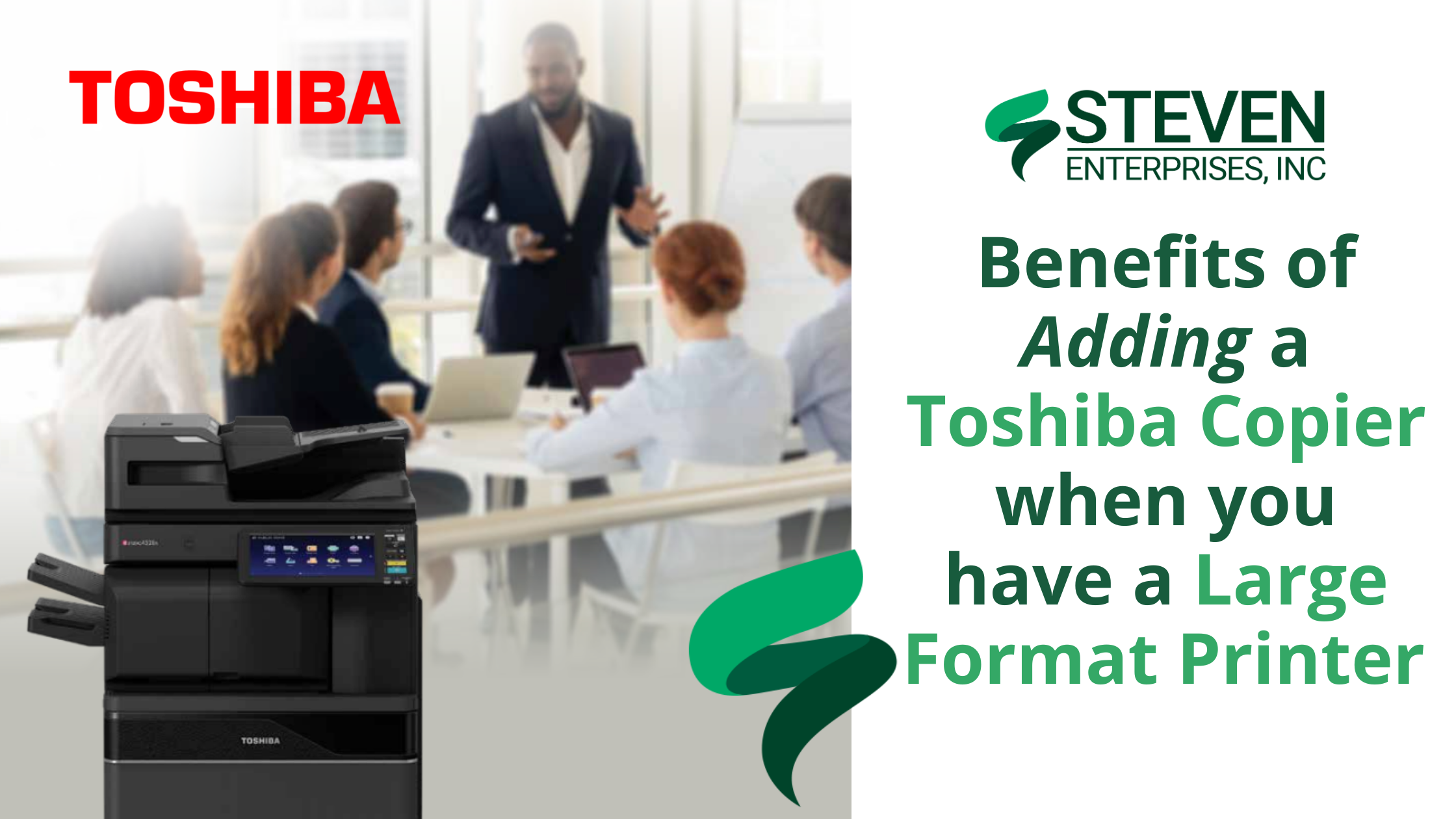
Benefits of Adding a Toshiba Copier When You Have a Large Format Printer

Benefits-of-Adding-a-Toshiba-Copier-when-you-have-a-Large-Format-Printer

In an effort to continue to provide the best printing solutions for our clients we’ve officially partnered with Toshiba to begin selling Toshiba copiers.

Many businesses, from small office workgroups to large firms with multiple departments, could save a great deal of money by adding a copier to their office alongside their large-format printers. Not only that but it has also been shown to increase productivity and optimize workflows.

In this article, we’ll review the benefits businesses may experience by adding a copier to their office and which Toshiba printers we are most impressed by

Why We Partnered With Toshiba

We partnered with Toshiba because they have some of the best full-featured Multifunction copiers today. 

One distinguishing feature is their compact design. In many cases, adding this copier can help create a powerful printing hub that streamlines workflows for teams mainly needing to copy & print. 

In addition, we were impressed by Toshiba’s advanced security and cloud features. Protecting data is a key focus, and Toshiba makes it easy and safe for hybrid teams to work from anywhere.

Lastly, the Toshiba multifunction printer line offers both black-and-white monochrome printers and color e-STUDIO machines to help maximize cost savings depending on your business needs. 

Businesses Who Could Benefit From Adding a Toshiba Copier

Almost every small office typically has a small-format copier. Whether you’re a construction firm, a local school, or a small office, your IT department or office manager has likely already purchased a copier (or has been begging for one!).

We have found that larger businesses that have previously invested in a wide-format printer might have yet to purchase a copier. Common businesses that could benefit from adding a copier to their workplace include AEC firms, school districts, design firms, government organizations, and school districts. 

These larger institutions hold off on buying a copier because they believe their large-format printer’s multi-functional features are enough. These expensive investments can already scan and copy documents, so why add another printing device to your office?

3 Reasons to Buy a Copier in Addition to Your Large Format Printer

Steven Enterprises printing experts recommend adding a copier to your printing hub if one of these three situations applies to your business. 

You print half-size formats regularly

If your team regularly prints half-size blueprints, you could save many supply costs by printing them on these Toshiba copiers. Depending on the model you choose, you can print 11×17 and 8×14 legal-size prints. So, you could likely take over those print jobs and save your large-format printer from wear and tear.

You have more than 3 print operators

There is no point in putting your large-format printer in overdrive if you have a large team of people accessing it daily. The printer has a very specific purpose: making high-quality large-format prints. Adding a copier could reduce wasted time waiting for prints in the cue and make your team more productive.

Pro Tip: Deciding which copier model to purchase comes down to speed. If you have 3 operators using the copier, you can probably get away with 25 pages per minute to avoid any bottlenecks. On the flip side, if you have a 30 person team, we’d recommend getting a copier capable of 65 pages per minute.

You need to lower ink costs

In many cases, businesses with a large format printer on-site use their printer for all its multifunctional capabilities (printing, scanning, and copying). However, since the cost per print is much higher than that of a basic copier machine, there are considerable savings.

Let’s say for example your team uses the large format printer to print 20K low-density prints per month. This would roughly be $0.2 per print, translating to $4000 per month in ink costs. If you were to train your team to print the rough drafts on the copier, you’d only pay $0.01 per black & white print, translating to only $200 ink costs per month! 

Need help calculating your cost savings? Get a free consultation with a printing expert here to have us run the numbers for you.

Most Popular Toshiba Copiers

Top Black & White Toshiba Copier

If your team is unnecessarily printing colored prints, investing in a Toshiba monochrome copier is a wise investment that will save money. Monochrome copiers only print black and white, so the business pays roughly $0.01/sheet (compared to roughly $0.68/sheet for color copiers). 

Of all the monochrome copiers Toshiba offers, our printing experts believe the Toshiba e-STUDIO 3528A is the most well-rounded copier in the series. 

It has everything from a super-charged document feeder to greater maximum paper capacity to next-level finishing performance; these new models raise the bar on what an MFP can do for productivity in the modern workplace.

Learn more about the Toshiba e-STUDIO 3528A here.

Top Colored Toshiba Copier

If your team needs to print in color but you think you could streamline your hybrid workflows by adding a copier, we recommend looking into the Toshiba Color MFP machines

Our printing experts were most impressed by the Toshiba e-STUDIO 2525AC. This powerful MFP copier takes up minimal space at the office and allows teams to and safely print from anywhere through cloud features.

Your team will be able to print, copy, scan, and fax with a small footprint, do so remotely with cloud features, and safeguard information with advanced security.

Learn more about the Toshiba e-STUDIO 2525AC here.

Interested in Purchasing a Copier for Your Business?

Let Steven Enterprises be your go-to source for identifying how much your business could benefit from adding a copier to your office. We’ll help you run the numbers so you can confidently invest in a copier, knowing it’ll save you costs and increase your productivity.

Simply fill out this form or call us at 800-491-8785 to speak with one of our  Equipment and Account Specialists for free and gain access to their in-depth industry experience. 


Posted on

What Large Format Printers is Best for K-12 Schools & Universities?

HP Z-series large format printer in a university setting, ideal for educational uses

As educational institutions like K-12 schools and universities upgrade their technology, large format printers are becoming increasingly essential.

The benefits? Significant cost savings and streamlined project timelines compared to outsourcing print jobs.

At Steven Enterprises, we have extensive experience assisting Southern California educational institutions in selecting and maintaining the perfect printers for their campus needs.

Based on their on-campus printing needs and available curriculum, this blog post will review the best large format printers for schools, including K-12 and universities. 

Common Types of Printing Done On School Campuses

Large format printers have a variety of applications on school campuses, impacting student life daily—from cafeterias and gyms to libraries and hallways.

1. School Event Promotion

Large-format printers are invaluable for promoting student events. They produce everything from: 

  • Signage for rallies, prom, and Greek life 
  • Large banners for sporting events & welcoming new students (up to 20 feet long!) 
  • Weather-resistant posters to promote ASB & other club activities  

2. Health and Safety Signage

Investing in an in-house large format printer allows schools to quickly produce and update health and safety signs—a crucial capability in today’s educational environments. This includes:

  • Floor decals to direct foot traffic 
  • Clings on bathroom mirrors to remind students to wash their hands
  • Large welcome signs to inform students of health and safety protocols (ideally in a fun and playful manner!)

3. Teaching Aids 

For educators, large format printers are tools to enhance their teaching methods creatively. Here are some examples of detailed informational prints that enrich the learning environment:

  • Large-scale game boards for the classroom 
  • Monthly calendars for bulletin boards 
  • Colorful customized maps 
  • Alphabet charts for memorization 
  • Galleries of photos from school outings
  • Informational graphics on classroom walls 

The possibilities are truly endless! If your school decides to invest in a large-format printer, it can enhance learning and improve the on-campus experience.

Best Large Format Printers for Schools

The HP Z-series is a popular choice among schools we partner with due to its versatility and cost-effectiveness. It supports various media types, paper thickness, and print sizes, making it ideal for simple signs and complex educational aids.

Learn more about the HP Z-series & get creative this school year!

Common Types of Printing Done by Universities

While universities share many of the same print needs as K-12 schools, their requirements often extend into more specialized areas. 

1. Bulk Printing for Essays, Quizzes, & More

Universities need robust printing solutions for the high volume of standard document printing required by students and faculty. Multi-functional printers in campus libraries or study centers are essential.

While these are not large format printers per se, our printing experts usually recommend the Toshiba printers. They have various models to print both A4 printers (printing the standard 8×14 pages) and A3 printers (printing slightly larger 11×17 pages) and are known to be reliable and easy to maintain. 

Learn more about the Toshiba multi-functional printers here.

2. Technical Prints for Engineering Students

High-quality technical printers are crucial for engineering departments. These printers allow for precise blueprints and detailed line work, mirroring the industry standards that students will encounter in their careers.

The innovative HP XL 3800 Large Format Printer, showcasing its superior color printing capabilities.

As a University, it pays dividends to purchase the latest printers being utilized within AEC firms to best prepare your students for the real world.

If your university has a large architecture, engineering, and construction curriculum, we recommend you upgrade your printer to the HP XL-3800.

READ MORE: New 2024 HP XL DesignJet 3800 Multi-Function Printer: A Comparison to Black & White Models

3. Graphic Prints for the Arts Department

Art and design departments benefit from printers that can handle detailed, high-quality graphic outputs. The Canon Pro series is highly regarded for its ability to produce exceptional photographic and graphic design prints, essential for student portfolios and final presentations.

Learn more about the Canon Pro Series here.

Best Large Format Printer for Universities

For a large university with diverse needs across various departments, it’s advisable to allocate a budget for both technical and graphic print capabilities. This ensures that all students have access to the necessary tools to support their education.

Read more: Choosing Between Graphic and Technical Large Format Printers for Your Business

Need Help Choosing the Right Printers for Your School or University?

At Steven Enterprises, we’re dedicated to helping educational institutions find the most suitable and cost-effective printing solutions. 

We offer personalized consultations to help you choose the right printers, ensuring you have the support needed for maintenance and supplies.

Contact us today to learn how the right large format printers can enhance the educational experience on your campus by either filling out this form or caling us at 800-491-8785.

Posted on 1 Comment

Toner vs. Ink Large Format Printers: Cost and Usage Comparison for Businesses

Comparison of toner and ink large format printers showing different supply costs

Choosing the right printing technology is crucial for optimizing your business’s operations and budget. 

One of the primary distinctions in large format printers is the type of printing technology they utilize—toner vs. ink large format printers.

So, if you’re just beginning your buying journey for a large format printer, the most critical question to answer early on is, “Should I be shopping for a toner-based large format printer and an ink-based large format printer?”

In this blog post, we’ll explain the main differences, ensuring you make an informed decision that aligns with your business needs.

Understanding the Core Differences Between Toner vs. Ink Large Format Printers

What Sets Toner Apart from Ink? 

Toner vs. Ink Large Format Printer supplies

Toner and ink serve the same fundamental purpose—creating images and text on paper—but their methods and outcomes vary greatly.

Inkjet printers use liquid ink sprayed in microscopic droplets onto paper, ideal for high-detail graphic outputs. 

Conversely, laser printers use fine powder toner that creates durable and fast-drying prints through a heat transfer process.

Understanding Composition & Quality Differences

Ink formulations typically include a blend of dyes or pigments and various additives that enhance printing quality and maintain ink fluidity. 

On the other hand, toner is a polymer-based powder that offers precision and efficiency and is especially suited for high-volume printing tasks.

Evaluating the Advantages and Disadvantages of Ink and Toner

Advantages of Using Ink in Large Format Printers:

  • Cost-Effectiveness for Lower Volumes: Inkjet printers generally have a lower upfront cost than ink-based printers, making them ideal for businesses with less intensive print needs.  
  • Superior Image Quality: Inkjets produce vibrant images with excellent detail, perfect for artistic and photographic applications.

Challenges with Ink-based large format printers

  • Maintenance Needs: Ink can dry out or clog the printing mechanisms if not used at least weekly, requiring regular maintenance. During COVID, many businesses had to purchase a brand new print head since repairing a clogged print head is almost impossible.
  • Higher Cost Per Print: While ink cartridges are cheaper, they yield fewer pages than toner, increasing the overall cost per print in high-volume environments.

Choosing Between Toner vs. Ink Large Format Printers

The decision between toner and ink ultimately hinges on your specific printing requirements:

For Low Volume Needs = Ink-based printers

If your monthly print needs are below 10,000 square feet, inkjet large format printers might be the more cost-effective choice despite the higher cost per square foot ($0.025) due to their lower upfront costs and high-quality outputs suitable for detailed designs.

For Higher Volume Requirements  = Toner-based printers

Toner-based large-format printers are more advantageous for volumes between 10,000 and 20,000 square feet per month. Toner’s cost efficiency ($0.011 per square foot) becomes evident in larger-scale operations, offering significant long-term savings.

To be clear, it’s rare for a business to have the minimum print volume required for a toner-based printer. For most companies in Southern California, purchasing this machine doesn’t make financial sense since the upfront costs are much higher. 

Making the Right Choice for Your Business

Selecting between ink and toner for your large format printing needs depends on various factors, including your typical print volume, the quality of prints required, and overall budget considerations. Both ink and toner have distinct advantages that can effectively serve different business needs.

To navigate these choices and find the perfect match for your business, consider consulting with a large format printing expert. 

At Steven Enterprises, we specialize in guiding businesses through these decisions, ensuring you invest wisely in technology that meets your specific requirements.

Book your free consultation by either filling out this form to have our experts contact you or calling us to talk to someone immediately at (800)491-8785.

Posted on

Top HP Wide Format Printers for 2025: Organized By Print Volume & Costs

Top HP wide format printer in action, ideal for high-volume printing

Balancing print volume with upfront costs is crucial when purchasing a HP wide format printer. 

High-volume printing demands fast speeds, which, if overlooked, could cost your business significantly in lost productivity and supply expenses.

Our specialists in HP wide format printers can calculate the most cost-effective options for your business, weighing both the immediate purchase costs and the long-term operational efficiencies.

HP is renowned for reliability and remains the leading choice in the printer market. Here’s our guide to the top HP wide format printers we recommend in 2025.

5 Best Selling HP Wide Format Printer Models in 2025

1. XL 5200 MFP (Multi-Function Printer)

The HP Pagewide XL series is celebrated for its rapid output capabilities, ideal for enterprise environments and repro houses requiring swift, high-quality technical documents.

This particular model from the XL series is the #1 best seller known for its low running costs and exceptional color accuracy. Offering a combination of technical prints and retail posters quickly and efficiently.

Why Purchase the XL 5200 MFP

  • Target Users: Ideal for large engineering firms and print shops with a monthly output of 5-10K square feet.
  • Speed: Delivers up to 20 D/A1 pages per minute
  • Size: 77mm W x 80.3mm D x 55.7mm in H
  • Main differentiator: Offer a combination of technical prints and short-term retail posters for maximum printing demands.

Learn more about the XL 5200 MFP here.

2. XL 4250 MSP (Multi-Function Printer)

Being a part of the XL series, this HP DesignJet XL 3800 MFP is known to be productive, efficient, and secure.  

The XL 4250 is slightly more affordable than the XL 5200, making it suitable for AEC firms printing around 5K square feet per month.

If you choose this printer, you sacrifice some speed—from 20 D/A1 pages per minute to 12 D/A1 pages per minute—but both remain wicked fast!

Why Purchase the XL 4250 MSP 

  • Target Users: Ideal for medium-sized engineering firms and print shops with a monthly output around 5K square feet.
  • Speed: Delivers up to 12 D/A1 pages per minute
  • Size: 1955 W x 785 D x 1414mm H 
  • Main differentiator: A great choice for firms needing high speed without the XL 5200’s capacity.

Learn more about the XL 4250 MSP.

3. DesignJet XL 3800 MFP

The next best-selling wide format printer by HP is the DesignJet XL 3800 MFP. 

This model is a powerhouse for sustained productivity. It can produce 6 D-sized color prints per minute, perfect for teams with a lower print volume.

What’s most impressive about this machine is the excellent CAD lines and graphics with high image quality delivered by new pigment-based inks. For the price we sell it, it’s a steal. 

Why Purchase the DesignJet XL 3800 MFP

  • Target Users: Architectural, Engineering, and Construction firm that prints below 5K square feet per month 
  • Speed: Up to 6 A1/D color pages per minute
  • Size: 1603 W x 614 D x 1225 mm H
  • Main differentiator: Offers superb CAD line quality and vibrant graphics at a competitive price.

Learn more about the DesignJet XL 3800 MFP.

4. DesignJet T1600 (Post-script)HP Designjet T1600 Front

The DesignJet T1600 is an economical choice for lower print volumes, providing simplicity and efficiency in smaller setups.

While slower, the large format printer is also more affordable. Your business will likely spend between $3K and $12K to purchase it, compared to $20K or more for the faster HP printer models.

One bonus about the DesignJet series is its much smaller footprint. This machine is only 55 inches long, compared to the XL series, typically around 80 inches. 

Why Purchase the DesignJet T1600

  • Target Users: Small offices, plumbing, contractors, and movie studios with 5-10 people printing 
  • Speed: Up to 180 D/hr² pages
  • Size: 55 x 30 x 43 in
  • Main differentiator: Costs significantly less upfront compared to higher-end models.

Learn more about the DesignJet T1600.

5. HP DesignJet XT950/ XT950 MFPWhy Purchase the HP DesignJet XT950

Compact and perfect for smaller spaces, this XT950 model handles half-size print jobs efficiently.

The benefit of this printer is that it has half-size print jobs. You’ll get integrated input and output trays sorted by size. Once you’re ready to pick up your jobs, the stacker can hold up to 40 pages flat for easy collection.

NOTE: If this doesn’t sound large enough, you’ll likely want to look into the DesignJet T1600 (mentioned above). 

Why Purchase the HP DesignJet XT950

  • Target Users: Smaller width machine perfect for job site trailers & home offices for 1-2 people printing 
  • Speed: Up to 21 sec/page for D size prints
  • Size: 55.4 W x 28.3 D x 38.1 in H
  • Main differentiator: Compact size & capability with half-size print jobs

Learn more about the HP DesignJet XT950.

Need Help Choosing Between the Top HP Wide Format Printers?

In a rapidly evolving engineering industry, staying ahead with the best tools is not just an option—it’s a necessity. 

Purchase the right large-format HP plotter for your business to reach new heights of efficiency and quality.

Let Steven Enterprises be your go-to source for identifying the right large-format printers for your business. Speak to one of our Equipment and Account Specialists to tap into their in-depth industry experience for free. 

Contact us today by filling out this form or call us immediately at 800-491-8785.


Related Article: How AEC Firms Can Maximize Savings on Large Format Printing Supplies

Posted on

MUTOH- A Dozen Years of Excellence

MUTOH

a dOZEN YEARS OF EXCELLENCE IN WIDE FORMAT PRINTING

A Legacy of Innovation

Product Excellence & Quality

Technological Advancements

Customer-Centric Approach

Industry Impact & The Future

Introduction

In the ever-evolving landscape of printing technology, MUTOH has established itself as a dependable company, consistently pushing the boundaries of innovation and setting benchmarks for excellence in wide format printing. For an impressive 12th consecutive year, MUTOH has  been honored by the PRINTING United Alliance for its unwavering commitment to product excellence and quality in the realm of wide format printers.

A Legacy of Innovation

MUTOH’S journey to becoming an industry leader is marked by a legacy of innovation. Since its inception, the company has been at the forefront of developing cutting-edge technology, staying ahead of the curve to meet the evolving needs of the printing industry. From the introduction of their first wide format printers to the latest state-of-the-art models, MUTOH has consistently delivered products that redefine standards.

Product Excellence & Quality

PRINTING United Alliance, a respected authority in the printing industry, has consistently acknowledged MUTOH’s contributions. The 12th consecutive year of recognition speaks volumes about the company’s dedication to maintaining the highest standards of product excellence and quality. This accolade not only reflects MUTOH’s commitment to its customers but also highlights its ability to stay relevant in an ever-changing market.

Technological Advancements

One key factor contributing to MUTOH’s continued success is its commitment to staying at the forefront of technological advancements. The company invests heavily in research and development, ensuring that its wide format printers incorporate the latest innovations. From enhanced color reproduction to improved printing speed, MUTOH’s products reflect a deep understanding of the industry’s demands.

Customer-Centric Approach

MUTOH’s success isn’t just about cutting-edge technology; it’s also about a customer-centric approach that permeates every aspect of the company. By actively listening to customer feedback and understanding their needs, MUTOH has been able to tailor its wide format printers to meet and exceed expectations. This customer-focused strategy has not only earned the company accolades but has also fostered long-term relationships with clients.

Industry Impact & Future Prospects

As an industry leader, MUTOH’s impact extends beyond its own success. The company’s advancements in wide format printing technology have a ripple effect, influencing the entire printing landscape. With each year of recognition from PRINTING United Alliance, MUTOH solidifies its position as a trailblazer, setting the standard for excellence that others strive to emulate.

Looking ahead, MUTOH’s commitment to innovation and quality suggests that its influence on the wide format printing industry will only continue to grow. As technology evolves and new challenges emerge, MUTOH is poised to lead the way, shaping the future of wide format printing.


MUTOH has proudly won four awards in the following output categories in 2023:

Check out MUTOH'S Award Winning Printers

Conclusion

MUTOH’s 12th consecutive recognition by PRINTING United Alliance is a testament to the company’s unwavering dedication to excellence in wide format printing. With a legacy of innovation, a commitment to technological advancements, and a customer-centric approach, MUTOH stands as a beacon in the industry, setting the standard for product excellence and quality. As the journey continues, MUTOH’s impact on the wide format printing landscape is sure to be both profound and enduring.

Posted on

A Dive into Cutting-Edge Technologies

A Dive into Cutting-Edge Technologies

Revolutionizing the Printing Industry in 2024

Photo by Geri Sakti on Unsplash

In the dynamic world of printing, advancements in technology have opened up new horizons, transforming traditional processes and paving the way for innovative applications. From inkjet to screen printing, the industry is witnessing a revolution that extends beyond conventional boundaries. In this blog, we’ll explore the latest improvements and application possibilities, ranging from direct-to-shape prints to the integration of printing technologies in diverse sectors like decor, textiles, sensors, and displays.

Improvements and Application Possibilities
to Explore in 2024

1

Inkjet Printing: Precision Redefined

2

Screen Printing's Resurgence: A Blend of Tradition and Innovation

3

Direct-to-Shape Printing: Breaking the Molds

4

Decor and Textiles: A Canvas of Infinite Possibilities

5

Sensors and Displays: Printing for the Future

Inkjet Printing: Precision Redefined

Inkjet printing has come a long way, evolving into a versatile technology with applications across various industries. The precision and flexibility of inkjet printers make them indispensable in tasks ranging from high-quality photo printing to large-scale poster production. Moreover, the ability to print on a wide range of surfaces, including unconventional materials, has expanded the possibilities for creative expression and customization.

Photo by engin akyurt on Unsplash

Screen Printing's Resurgence: A Blend of Tradition and Innovation

Despite the rise of digital printing, screen printing has found a resurgence by combining traditional techniques with modern innovations. The process's adaptability to various substrates and its cost-effectiveness make it an attractive choice for applications like packaging, textiles, and promotional items. Advances in screen printing technology have enhanced its efficiency and reduced environmental impact, contributing to its renewed popularity.

Photo by Steven Roxas on Unsplash

Direct-to-Shape Printing: Breaking the Molds

The introduction of direct-to-shape printing has revolutionized the way we approach product customization. Whether it's printing on curved surfaces, irregular shapes, or 3D objects, this technology eliminates the need for additional labeling or branding processes. Industries such as manufacturing, automotive, and consumer electronics benefit from the efficiency and precision of direct-to-shape printing, streamlining production processes and enhancing branding possibilities.

Decor and Textiles: A Canvas of Infinite Possibilities

Printing has become an integral part of the decor and textile industries, enabling the creation of unique patterns, designs, and textures. Digital textile printing, in particular, has gained prominence for its eco-friendly approach and the ability to produce intricate and vibrant designs on fabrics. Decorative applications, including wallpaper and customized furnishings, showcase the fusion of technology and aesthetics.

Sensors and Displays: Printing for the Future

The integration of printing technologies in the development of sensors and displays marks a significant leap forward. Printed electronics enable the creation of flexible, lightweight, and cost-effective electronic components. From flexible displays to smart packaging with built-in sensors, these applications showcase the potential of printed electronics in revolutionizing the way we interact with technology.

Photo by Sticker it on Unsplash

Photo by Austin Chan on Unsplash

Want to do more with your printer? It’s time! The printing industry’s evolution from traditional methods to cutting-edge technologies has unlocked a world of possibilities. Inkjet and screen printing continue to thrive, each finding its niche in diverse applications. Direct-to-shape printing is reshaping product branding, while the decor and textile industries embrace digital printing for unparalleled creativity. The integration of printing in sensors and displays heralds a future where everyday objects become smarter and more interactive. As we stand on the cusp of this printing revolution, the industry’s trajectory promises continuous innovation and limitless potential.

Posted on

A Year of Innovation: Advancements in Large-Format Printing in 2023

A Year of Innovation: Advancements in Large-Format Printing in 2023

Photo by Matt Ridley on Unsplash

In the dynamic world of large-format printing, 2023 has been a year marked by remarkable advancements and innovations. From enhanced printing technologies to sustainable practices, the industry has experienced notable growth and transformation. Let’s delve into the key developments that have shaped the large-format printing landscape over the past year.

1. Next-Generation Wide Format Plotters

Manufacturers have continued to push the boundaries of wide format plotters, introducing cutting-edge models that boast higher resolutions, faster printing speeds, and improved color accuracy. These next-gen plotters cater to the diverse needs of industries such as architecture, engineering, and design.

2. Ink and Toner Innovations

The quest for superior print quality and longevity has driven significant advancements in ink and toner formulations. New formulations not only deliver vibrant and durable prints but also contribute to improved environmental sustainability. Reduced waste and eco-friendly options have become key considerations for businesses investing in large-format printing supplies.

3. Printers Embracing Sustainability

As environmental consciousness continues to rise, large-format printer manufacturers have made significant strides in adopting sustainable practices. This includes the development of energy-efficient printers, the use of recycled materials in manufacturing, and the implementation of eco-friendly ink and toner cartridges. These initiatives align with the growing demand for greener alternatives in the printing industry.

4. Integration of AI and Automation

Artificial intelligence has found its way into large-format printing workflows, streamlining processes and enhancing efficiency. AI-powered algorithms are being utilized for color correction, image enhancement, and even predictive maintenance, ensuring optimal performance and minimizing downtime.

5. Expanding Application Capabilities

Large-format printing is no longer limited to traditional applications. The industry has witnessed a surge in the adoption of 3D printing technologies for creating visually stunning and intricate designs. Additionally, advancements in UV-curable inks have opened up new possibilities for printing on a broader range of materials, including glass, metal, and ceramics.

6. Cloud-Based Printing Solutions

The integration of cloud-based printing solutions has revolutionized the way businesses manage their printing workflows. This technology enables users to access and control their large-format printers remotely, enhancing flexibility and collaboration in a rapidly changing work environment.

7. Small Format Printers Evolving

While large-format printing steals the spotlight, small format printers have not been left behind. Manufacturers continue to refine and enhance these printers, making them more compact, efficient, and capable of delivering high-quality prints. The synergy between small and large format printing technologies is creating seamless and versatile printing environments.

Photo by Aakash Dhage on Unsplash

The year 2023 has undeniably been a transformative period for the large-format printing industry. From the introduction of advanced wide format plotters to sustainable practices and the integration of cutting-edge technologies, these advancements set the stage for a future where large-format printing is not only powerful but also environmentally conscious and versatile. As we move into the next year, the trajectory of innovation in this dynamic field is poised to continue, offering exciting possibilities for businesses and creative professionals alike.

Check out our selection of wide format printers!

Need help with finding the right solution?